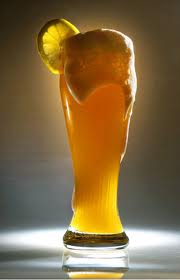
Boulevard Brewing Co.’s Bob’s ’47 clone
A tribute to Bob Werkowitch, former Master Brewer of Kansas City’s George Muehlebach Brewing Company and graduate of the U.S. Brewer’s Academy class of 1947. Bob’s ‘47 is Boulevard’s take on a traditional German-style Märzen/Oktoberfest.

Boulevard Brewing Co.’s Bob’s ’47, all-grain clone
(5 gallons/19 L)
OG = 1.055 FG = 1.011
IBU = 27 SRM = 11 ABV = 5.8%
Ingredients
6.6 lbs. (3 kg) North American 2-row Pilsner malt
3.3 lbs. (1.5 kg) Munich malt (10 °L)
0.66 lb. (300 g) Munich malt (15 °L)
0.66 lb. (300 g) European crystal malt (50 °L)
0.15 lb. (70 g) European crystal malt (15 °L)
5 AAU Vanguard hops (60 min.) (1 oz./28 g at 5% alpha acids)
2.5 AAU Vanguard hops (30 min.) (0.5 oz./14 g at 5% alpha acids)
SafLager W34/70 or Omega Yeast Labs OYL-114 (Bayern Lager) or White Labs WLP830 (German Lager) or Wyeast 2124 (Bohemian Lager) yeast
3⁄4 cup corn sugar (if priming)
Step by Step
This recipe uses reverse osmosis (RO) water. Adjust all brewing water to a pH of 5.5 using phosphoric acid. Add 1 tsp. calcium chloride to the mash.

Mash the malts at 152 °F (67 °C) for 60 minutes. Start recirculating wort. Raise the temperature to 168 °F (76 °C) for 15 minutes. Sparge slowly and collect 6.5 gallons (24.5 L) of wort.
Heat to boiling, and boil the wort for 90 minutes, adding hops at the times indicated in the recipe. Adjust OG post-boil with RO water as required.
Chill the wort to 50–54 °F (10–12 °C), pitch the yeast, and ferment until complete. Lager at fermentation temperature (50–54 °F/10-12 °C) for 2 weeks, then cool to 32–34 °F (0–1 °C) and cold condition for four days.
If you have a spunding valve, transfer beer from primary to keg when gravity is about 1.020, close keg, pressurize to ~5 psig to seal lid, attach spunding valve, and hold at fermentation temperature (50–54 °F/10–12 °C) for 3 weeks. Cool to 32–34 °F (0–1 °C) and cold condition for four days before serving.
Boulevard Brewing Co.’s Bob’s ’47, partial mash clone
(5 gallons/19 L)
OG = 1.055 FG = 1.011
IBU = 27 SRM = 11 ABV = 5.8%
Ingredients
3.5 lbs. (1.4 kg) Pilsen dried malt extract
1 lb. (0.45 kg) Munich dried malt extract
1.5 lbs. (0.68 kg) Munich malt (10 °L)
0.66 lb. (300 g) Munich malt (15 °L)
0.66 lb. (300 g) European crystal malt (50 °L)
0.15 lb. (70 g) European crystal malt (15 °L)
5 AAU Vanguard hops (60 min.) (1 oz./28 g at 5% alpha acids)
2.5 AAU Vanguard hops (30 min.) (0.5 oz./14 g at 5% alpha acids)
SafLager W34/70 or Omega Yeast Labs OYL-114 (Bayern Lager) or White Labs WLP830 (German Lager) or Wyeast 2124 (Bohemian Lager) yeast
3⁄4 cup corn sugar (if priming)
Step by Step
Start with 1.5 gallons (5.6 L) of water in the brew kettle; heat to 158 °F (70 °C). Steep the crushed malts in a mesh bag for 45 minutes, then remove.
Add 5 gallons (19 L) more of water, rinsing the grain bag during addition; heat to 180 °F (82 °C).
Turn off the heat. Add the malt extract, and stir thoroughly to dissolve completely. Turn the heat back on and bring to a boil. Boil the wort for 60 minutes, adding hops at the times indicated in the recipe. Adjust OG post-boil with RO water as required.
Chill the wort to 50–54 °F (10–12 °C), pitch the yeast, and ferment until complete. Lager at fermentation temperature (50–54 °F/10–12 °C) for 2 weeks, then cool to 32–34 °F (0–1 °C) and cold condition for four days.
If you have a spunding valve, transfer beer from primary to keg when gravity is about 1.020, close keg, pressurize to ~5 psig to seal lid, attach spunding valve, and hold at fermentation temperature (50–54 °F/10–12 °C) for 3 weeks. Cool to 32–34 °F (0–1 °C) and cold condition for four days before serving.