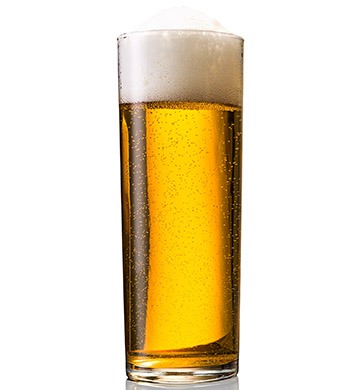
Brooklyn Brewery: Brooklyn Lager clone
Brooklyn Lager is Brooklyn Brewery’s flagship beer. It is loosely based on the old Vienna lager style, derivations of which were popular in parts of the United States in the late 1800s. Its bitterness is snappy, with a firm malt core, and the beer is dry hopped.

Brooklyn Brewery: Brooklyn Lager clone, All-Grain
(5 gallons/19 L, all-grain)
OG = 1.052 FG = 1.012
IBU = 30 SRM = 13 ABV= 5.2%
Ingredients
9 lb. 6 oz (4.25 kg) American 2-row pale malt
14 oz. (0.40 kg) Munich malt (10°L)
11 oz. (0.31 kg) caramel malt (60°L)
4.6 AAU Willamette hops (75 mins.) (1 oz./28 g of 4.6% alpha acids)
2.5 AAU Cascade hops (35 mins.) (0.33 oz./9.3 g of 7.5% alpha acids)
2.5 AAU Vanguard hops (35 mins.) (0.45 oz./13 g of 5.6% alpha acids)
0.5 oz. (14 g) Hallertau Mittelfrueh hops (2 mins.)
0.5 oz. (14 g) Saphir hops (2 mins.)
0.5 oz. (14 g) Cascade hops (2 mins.)
0.75 oz. (21 g) Cascade hops (dry hops)
1.5 oz. (42 g) Hallertauer Mittelfrueh hops (dry hops)
White Labs WLP833 (German Bock Lager) yeast
Step by step
Mash the grains at 118°F (47°C) for 20 minutes. Ramp up to 135°F (57°C) and hold for 5 minutes. To reach the saccharification temperature of 156°F (69°C), there are two methods, depending on your equipment. If your heat source can raise the temperature of the mash rapidly (in 5 to 10 minutes), then do so. If not, add 200°F (93°C) water to the mash, stirring vigorously to avoid hot spots, until you reach the target temperature. (American 2-row pale malt is diastatically powerful, and if the mash isn’t heated quickly enough, the resulting wort will be too fermentable.) Hold for 35 minutes at 156°F (69°C), then ramp up to mash out at 170°F (77°C). Vorlauf and then sparge at 170°F (77°C) until you’ve collected enough wort (gravity should be 13°P/1.053 SG).

Boil for 75 minutes, adding the hops as instructed. (Brooklyn Brewery’s boil is 15 minutes longer, but boiling longer over a direct flame would result in too much color development). If necessary, adjust the volume to 5 gallons (19 L). Cool to 55°F (13°C) and pitch the yeast.
Once activity has clearly started (approximately 24 hours for lagers), ferment at 52°F (11°C). As activity subsides toward the end of fermentation, allow a free rise to 60°F (16°C) over 48 hours. Once the fermentation is finished, bring the temperature to 36°F (2.2°C) for lagering. After 1 week at 36°F (2.2°C), add the dry hops and hold for 10 days. Bottle or keg as usual.
Extract with Grains Option: Scale the American 2-row pale malt down to 7 ounces (0.2 kg) and add 2 pounds (0.91 kg) Briess light dried malt extract and 4 pounds (1.8 kg) Briess light liquid malt extract to the ingredients list. Place the crushed grains in a steeping bag and steep in 3 quarts (2.8 L) of water in your brewpot at 154°F (68°C) for 60 minutes. Lift the grain bag and place it in a colander suspended over the brewpot. Rinse the grains with 1.5 quarts (1.4 L) of 170°F (77°C) water. Add water to the “grain tea” to make at least 3.5 gallons (13 L), then dissolve the dried malt extract and bring to a boil. Boil for 75 minutes, adding the hops at the times indicated. Stir in the liquid malt extract during the final 15 minutes of the boil. Chill, then top up with filtered water to reach 5 gallons (19 L). Follow the remaining portion of the all-grain recipe.