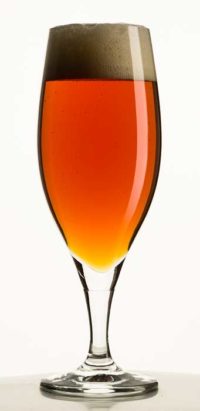
Roswell IPA
Roswell IPA, All-Grain
(5 gallons/19 L, all-grain)
OG = 1.070 FG = 1.014
IBU = 60 SRM = 8 ABV = 7.7%
Ingredients
13 lbs. 9 oz. (6.15 kg) US 2-row pale malt
11 oz. (0.31 kg) Vienna malt
5 oz. (0.14 kg) crystal malt (30 °L)
14 AAU Magnum hops (60 min.) (1 oz./28 g at 14% alpha acids)
3.8 AAU Centennial hops (15 min.) (0.38 oz./11 g at 10% alpha acids)
3.75 AAU Cascade hops (5 min.) (0.75 oz./21 g at 5% alpha acids)
0.75 oz. (21 g) Cascade hops (dry hop)
0.5 oz. (14 g) Amarillo® hops (dry hop)
1 tsp. Irish moss (15 min.)
1⁄2 tsp. calcium chloride (optional)
Wyeast 1056 (American Ale), White Labs WLP001 (California Ale), or Safale US-05 yeast (3 qt./~3 L yeast starter)
3⁄4 cups corn sugar (if priming)
Step by Step
Prepare 12 gallons (45 L) of brewing liquor with bicarbonate below 50 ppm and calcium around 75 ppm. (Adding 3.5 tsp. of gypsum to 12 gallons/45 L of soft water will get you there.) Add a Campden tablet the night before you brew to get rid of chlorine compounds. Mash grains at 152 °F (67 °C) in 18 qts. (17 L) of water. Rest for 60 minutes, then mash out to 168 °F (76 °C). Recirculate wort for 20 minutes, then collect around 7 gallons (26 L) of wort in your kettle. Keep your sparge water hot enough that the grain bed temperature remains at 168 °F (76 °C).
Boil wort vigorously for 90 minutes, adding hops at times indicated. (As an option, add 1⁄2 tsp. calcium chloride at the beginning of the boil.) Knock any hops that cling to the side of your kettle back into the boiling wort. Cool wort and transfer to fermenter.

Aerate thoroughly and pitch sediment from yeast starter. Ferment at 68 °F (20 °C) until primary fermentation ends. (This should take about a week.) Rack to secondary fermenter. If you are going to bottle your beer, let it sit for three to four days, add the dry hops and let the beer sit for another three to four days, then bottle it. If you are going to keg your beer, let the beer sit in secondary until it clears substantially (7–10 days), then keg and dry hop.
Roswell IPA, Partial Mash
(5 gallons/19 L, partial mash)
OG = 1.070 FG = 1.014
IBU = 60 SRM = 8 A BV = 7.7%
Ingredients
5 lbs. 10 oz. (2.6 kg) Briess light dried malt extract
3 lbs. (1.4 kg) US 2-row pale malt
11 oz. (0.31 kg) Vienna malt
5 oz. (0.14 kg) crystal malt (30 °L)
14 AAU Magnum hops (60 min.) (1 oz./28 g at 14% alpha acids)
3.8 AAU Centennial hops (15 min.) (0.38 oz./11 g at 10% alpha acids)
3.75 AAU Cascade hops (5 min.) (0.75 oz./21 g at 5% alpha acids)
0.75 oz. (21 g) Cascade hops (dry hop)
0.5 oz. (14 g) Amarillo® hops (dry hop)
1 tsp. Irish moss (15 min.)
1⁄2 tsp. calcium chloride (optional)
Wyeast 1056 (American Ale), White Labs WLP001 (California Ale), or Safale US-05 yeast (3 qt./~3 L yeast starter)
3⁄4 cups corn sugar (if priming)
Step by Step
Steep grains at 152 °F (67 °C) in 6 qts. (5.7 L) of water for 60 minutes. In your brewpot, combine “grain tea” and hot water to make at least 4 gallons (15 L) of wort, then stir in malt extract. Boil wort for 60 minutes.
Cool wort and transfer to fermenter. Aerate thoroughly and pitch sediment from yeast starter. Ferment at 68 °F (20 °C) until primary fermentation ends. (This should take about a week.) Rack to secondary fermenter. If you are going to bottle your beer, let it sit for three to four days, add the dry hops and let the beer sit for another three to four days, then bottle it. If you are going to keg your beer, let the beer sit in secondary until it clears substantially (7–10 days), then keg and dry hop.