Controlling Diacetyl
Yeast is an amazing organism. It is responsible for producing bread, wine, distilled beverages, and beer. When yeast ferments beer, it produces more than 500 different compounds. Many of these compounds give beer its characteristic flavor and aroma. One of these compounds — one that is usually considered undesirable — is diacetyl.
Diacetyl gives a buttery, butterscotch-like flavor to beer. The flavor threshold of diacetyl — the level at which it can be perceived — is 0.1 parts per million (ppm) in “light” beer (such as Budweiser and Miller). Homebrewed beer can have levels from 0.05 to greater than 1 ppm.
Factors that influence the diacetyl level in beer are fermentation temperature, aeration level, bacterial contamination, and the yeast strain. Diacetyl levels vary during the course of fermentation and maturation. (See Typical Diacetyl Time Line below.)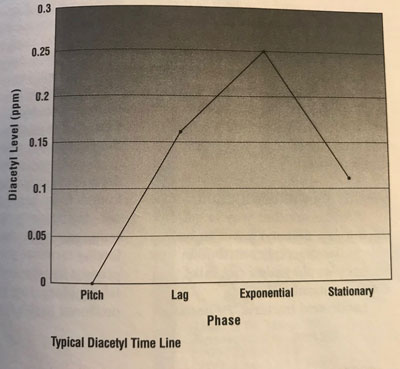
Fermentation Control
Diacetyl is a small organic compound belonging to the chemical group called ketones.

After yeast is pitched into beer, the yeast undergo a lag phase, followed by a phase of very rapid growth called the exponential growth phase. During both the lag and exponential phase, yeast build amino acids, proteins, and other cell components.
One of the amino acids produced by yeast is valine. An intermediate compound in valine production is called acetolactate. Not all of the acetolactate produced eventually becomes valine; some will leak out of the cell and into the beer. This acetolactate is then chemically converted to diacetyl in the beer. The chemical reaction is an oxidation, and high fermentation temperatures favor this reaction. The higher the temperature, the more acetolactate is converted into diacetyl.
Another factor that increases diacetyl production in this phase is insufficient nutrients. Valine is one yeast nutrient. Valine levels vary by type of malt. If there is not enough valine (or other yeast nutrient), the yeast will produce its own. But the more valine yeast produce, the more acetolactate intermediate is required, and hence the more diacetyl made. There is a strain-specific phenomenon here, because given the same conditions, different strains produce different levels of diacetyl.
The Stationary Phase
As yeast slow down in fermentation, they enter what is known as the stationary phase. This phase is when beer undergoes a maturation process to develop the correct balance of flavors. One of the key elements of maturation is diacetyl reduction. Not only do yeast produce the precursor to diacetyl, they also consume the diacetyl that is produced and enzymatically reduce it. Yeast reabsorb diacetyl and convert it to acetoin and subsequently to 2,3-butanediol.
Acetoin and 2,3-butanediol have high flavor thresholds (they are difficult to detect), and so neither contributes much in terms of flavor.
Give It a Rest
It is important to provide sufficient maturation time for diacetyl reduction. This step is commonly known as a “diacetyl rest.” Diacetyl reduction is slower at colder temperatures, so it is essential to incorporate the diacetyl rest when making cold-fermented lagers.
The process is simply to raise the fermentation temperature from lager temperatures (50 to 55 °F/10 to 13 °C) up to about 65 to 68 °F (18 to 20 °C) for a two-day period near the close of the fermentation. Usually the diacetyl rest is begun when the beer is two to five specific gravity points away from the target terminal gravity. The temperature is then lowered to conditioning temperature following diacetyl reduction.
For ale production, the fermentation temperature is usually 65 to 70 °F (18 to 21 °C), so temperature modification is not necessary. But the fermentation should still be “rested” at this temperature for two days to ensure proper diacetyl reduction. Many brewers make the mistake of quickly crashing the fermentation temperature following terminal gravity. Why not? The beer is done, people are thirsty, and there is no taste of diacetyl in the beer.
Even though the diacetyl can’t be tasted, however, the beer might contain high levels of the precursor, acetolactate, which can be converted to diacetyl. Once the yeast is removed, there is no way to get rid of the diacetyl.
Caused by Contamination
There is another way to get the buttery, diacetyl flavor in beer. This is the diacetyl contribution that brewers would rather not talk about: contamination.
Lactic acid bacteria, Pediococcus and Lactobacillus, produce diacetyl. These bacteria have historically been notorious contaminators of beer and are called beer spoilers. They are anaerobic and tolerant to alcohol and heat. This makes them happy to live in beer. The diacetyl produced by bacteria is far from pleasant and can taste like sour butter.
Small breweries and homebrewers have a difficult time bottling beer in a manner that eliminates lactic acid bacteria. This is one reason great-tasting beer can be bottled, only to develop pressure, sourness, and diacetyl flavors in as little as two months. What can be done? Sanitize well, bottle carefully, and leave some yeast in suspension. This yeast won’t kill bacteria, but it will reduce any diacetyl produced from oxidation of acetolactate in the bottle.
Inviting Diacetyl?
Most brewers do not like the presence of diacetyl in their beer because it is a hint of a possible fermentation or contamination problem. But some brewers desire their beer to contain diacetyl in the final product. For example Redhook ESB has a characteristic diacetyl taste. This is most likely produced from the yeast strain used or from the fermentation profile employed.
Some yeast strains, particularly flocculent English ale strains, are known to be heavy diacetyl producers. Alternatively, the fermentation temperature can be crashed following terminal gravity, which would prevent the diacetyl rest from taking place. Low levels of diacetyl produced in this manner can be pleasant, and many classic beer styles such as Scotch ales and bitters allow for low levels of diacetyl to be tasted in the beer.
Diacetyl Formation Facts
- Some yeast strains produce a lot of diacetyl, while others produce less. Choose yeast that produces less, unless you are brewing a style that allows for the presence of diacetyl.
- High fermentation temperatures promote diacetyl production.
- Low aeration levels when yeast is pitched will produce less healthy yeast, which are prone to higher diacetyl production.
- Ale fermentations produce more diacetyl because ales are fermented warmer than lagers, but the reduction happens much quicker.
- Lager fermentations need to be given a “diacetyl rest” by increasing the fermentation temperature just before completing fermentation.
- A hydrometer should be used to measure the specific gravity to calculate when to start the diacetyl rest. Begin when the beer reaches two to five points of final gravity.
- The fermentation should never be rushed. Give the beer ample time for maturation.
- Sanitize well, particularly when bottling, to limit the effect of diacetyl from bacterial contamination.