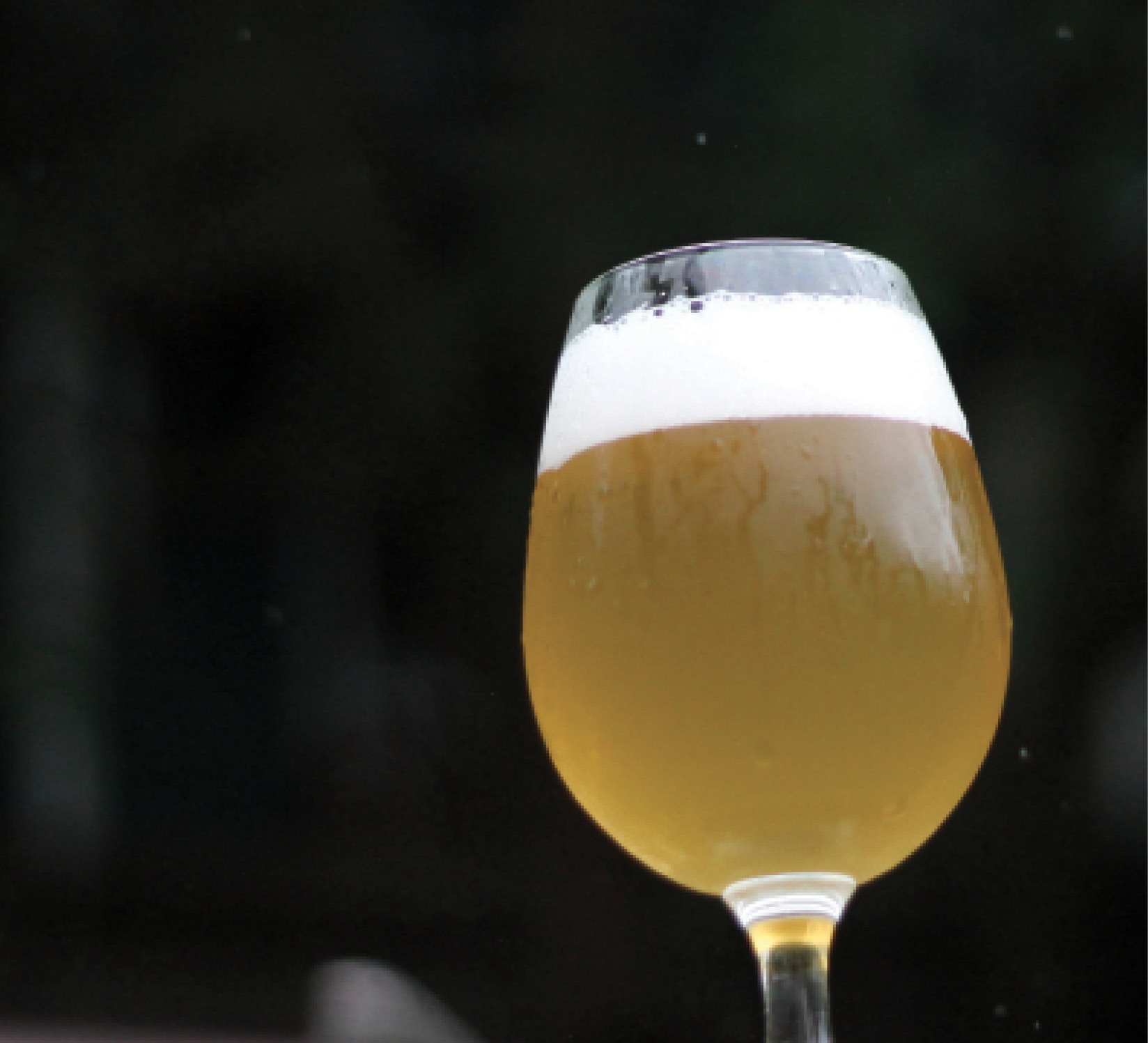
Goshen Brewing Co.
Dear Replicator, I recently tried an excellent saison called Pyramid of Skulls from Goshen Brewing Co. in Goshen, Indiana. It has an excellent flavor profile, with white grape being the very forward flavor. Their website doesn’t list the hop used for that delicious flavor or give many hints to begin with clone recipe development. I would like to make something with that great taste if you’re able to help!
Larry Peters,
Osceola, Indiana
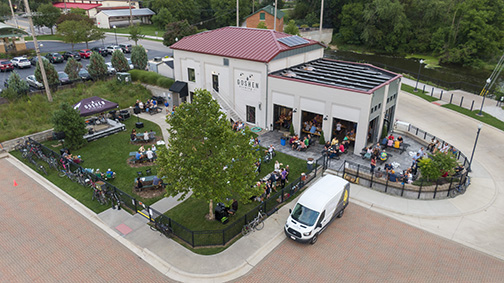
Jesse and Amanda Sensenig are both natives of Goshen, Indiana, and Goshen College graduates, though their passion for craft beer developed further from home while living in Charleston, South Carolina, and Fort Collins, Colorado. Inspired by the dense, high-quality brewing culture of Fort Collins, Jesse began developing his own recipes. Upon returning home to Indiana, the Sensenigs started envisioning a space that prioritized conversation and connection. The culmination of their dream was Goshen Brewing Company, which the Sensenigs built out from a repurposed Northern Indiana Public Service Company building.
The brewery has grown steadily over the past 11 years, adding a second bar, increasing brewing capacity, and even introducing hard cider made from local apples. While the business has largely focused on in-house pub sales, an upcoming production expansion is planned to increase the brewery’s distribution, barrel-aging program, as well as their lager program.
Head Brewer Derek Lambacher began homebrewing in college and learned what he could through the hobby before landing a part-time gig at a local brewery just before graduation. As Goshen Brewing expanded, Lambacher took the opportunity to join the team and eventually worked his way up to head brewer by tackling recipe development, production planning, and tighter quality control.

As a brewer, Lambacher has evolved by leaning into technical precision. Like many brewers, he’s developed a deep appreciation for the delicacies of a well-made lager. “The subtlety and precision involved in lager brewing, not to mention the refreshing sessionability, keeps drawing me to those styles,” he says. His approach to hops has also radically shifted, moving away from simple kettle additions in favor of whirlpooling, active fermentation dry hopping, and advanced hop products.
Developing these techniques has not only shaped how Lambacher approaches the IPAs he brews, but many other styles as well. For the past three years, Goshen’s summer seasonal has been Pyramid of Skulls, a saison that marries the rustic, spicy tradition of a classic Belgian-style ale with the bright, fruity punch of a modern IPA.
“While the base of the beer looks like a typical saison recipe, the addition of Nelson SauvinTM in the dry hop adds a more modern hop profile,” Lambacher explains. “Overall, it’s firmly rooted in saison, but the dry hopping gives it a more contemporary, hop-forward expression.”
The malt bill is straightforward but purposeful: Pilsner malt provides a simple, crisp base, with white wheat bolstering the body and mouthfeel and rye adding a touch of rustic spice to complement the phenols from the yeast. For the hot-side, Lambacher keeps the bittering smooth and traditional with Spalter Select hops. The Nelson SauvinTM dry hop — 1.5 lbs. per bbl. at Goshen’s production scale — is more than enough to set the beer apart from other saisons on the market.
For his yeast, Lambacher opts for White Labs WLP550 (Belgian Ale). While some brewers prefer to under-pitch or under-aerate their saisons to stress the yeast into producing massive ester profiles, Lambacher has found this to be unnecessary. “I treat this yeast like any other ale in terms of pitch rate. Rather than chasing additional ester production through under-pitching or limiting oxygen, I’d rather produce those flavors through healthy fermentation and temperature management,” he says. He prefers to add yeast nutrient near the end of the boil and a zinc supplement during knockout, which help ensure yeast health. Since yeast nutrients homebrewers use generally include zinc, homebrewers will be fine without an additional zinc addition.

Lambacher recommends cooling the wort to about room temperature before pitching and then allowing the temperature to free rise only slightly (to around 71 °F/22 °C) the next day. Homebrewers should be mindful of one quirk of Lambacher’s recommended yeast strain, however: Sulfur. Still, as long as the yeast is healthy and the pitch rate is correct, he believes that patience is enough to get around this — the yeast will naturally scrub the sulfur out of the beer over time. Homebrewers should therefore give the yeast plenty of time to finish fermentation before moving on to the dry hop.
“Nelson SauvinTM’s white grape and tropical fruit character complements the peppery phenols and fruity esters produced by the Belgian yeast rather than competing with them,” he says.
Lambacher encourages homebrewers to take detailed sensory notes and not be afraid of crossing traditional boundaries. “Historically, many saisons were dry hopped, and while it may seem a bit odd to add New Zealand hops to a saison, I think it fits perfectly within the spirit of the style.”
Goshen Brewing Co.’s Pyramid of Skulls clone
(5 gallons/19 L, all-grain)
OG = 1.058 FG = 1.008
IBU = 30 SRM = 4 ABV = 6.5%
Ingredients
9 lbs. (4.1 kg) Pilsner malt
2 lbs. (0.9 kg) white wheat malt
1 lb. (0.45 kg) rye malt
6 AAU Spalter Select hops (60 min.) (1.5 oz./43 g at 4% alpha acids)
4 AAU Spalter Select hops (15 min.) (1 oz./28 g at 4% alpha acids)
4 oz. (113 g) Nelson SauvinTM hops (dry hop)
1⁄2 tsp. yeast nutrient (15 min.)
White Labs WLP550 (Belgian Ale) yeast, Wyeast 3522 (Belgian Ardennes), or Mangrove Jack’s M31 (Belgian Tripel) yeast
3⁄4 cup corn sugar (if priming)
Step by Step
Mash in with 3.5 gallons (13.2 L) of water to achieve a single infusion rest temperature of 152 °F (67 °C). Hold at this temperature for 60 minutes.
With sparge water at 170 °F (77 °C), collect about 6 gallons (23 L) of wort. Bring wort to a boil.
At the start of the boil, set a timer for 60 minutes and add the first Spalter Select hop addition. With 15 minutes remaining in the boil, add the second Spalter Select hop addition and the yeast nutrient.
Chill the wort to 68 °F (20 °C). Oxygenate normally and pitch the yeast. Allow the fermentation temperature to free rise to 71 °F (22 °C) the following day and then keep there the remainder of fermentation. After two to three weeks, ensure fermentation is complete and crash the beer to 54 °F (12 °C). The following day, add the Nelson SauvinTM dry hops. Hold at 54 °F
(12 °C) for 2–3 days.
Add priming sugar and bottle condition or keg and force carbonate to 2.8–3.0 volumes.
Goshen Brewing Co.’s Pyramid of Skulls clone
(5 gallons/19 L, extract only)
OG = 1.058 FG = 1.008
IBU = 30 SRM = 4 ABV = 6.5%
Ingredients
4.5 lbs. (2 kg) Pilsner dried malt extract
1 lb. (0.45 kg) wheat dried malt extract
1 lb. (0.45 kg) rye liquid malt extract
6 AAU Spalter Select hops (60 min.) (1.5 oz./43 g at 4% alpha acids)
4 AAU Spalter Select hops (15 min.) (1 oz./28 g at 4% alpha acids)
4 oz. (113 g) Nelson SauvinTM hops (dry hop)
1⁄2 tsp. yeast nutrient (15 min.)
White Labs WLP550 (Belgian Ale) yeast, Wyeast 3522 (Belgian Ardennes), or Mangrove Jack’s M31 (Belgian Tripel) yeast
3⁄4 cup corn sugar (if priming)
Step by Step
Add 6 gallons (23 L) of water to a kettle. Bring to a boil, then turn off the heat and carefully stir in the malt extracts until fully dissolved. Return to a boil and set a timer for 60 minutes, then add the first Spalter Select hop addition. With 15 minutes remaining in the boil, add the second Spalter Select hop addition and the yeast nutrient.
Chill the wort to 68 °F (20 °C). Oxygenate normally and pitch the yeast. Allow the fermentation temperature to free rise to 71 °F (22 °C) the following day and then keep there the remainder of fermentation. After two to three weeks, ensure fermentation is complete and crash the beer to 54 °F (12 °C). The following day, add the Nelson SauvinTM dry hops. Hold at 54 °F (12 °C) for 2–3 days.
Add priming sugar and bottle condition or keg and force carbonate to 2.8–3.0 volumes.