Second Chapter Brewing
Dear Replicator,
I’ve always been a fan of a good classic Belgian wit, but it’s a style that seems to have fallen off brewer’s radars for a few years now. After getting the chance to spend some time in Second Chapter Brewing’s unique taproom (it’s a brewery in a former library), I was hoping to learn some tips for their process in brewing their witbier Witty Librarian. Anything you can find out would be appreciated, cheers!
Dan Crawford
Denver, Colorado
Many breweries have found themselves in unique locations, but few have found a location-based story as compelling as Second Chapter Brewing, found in Ogallala, Nebraska.
Husband and wife owners Richard Gibson and Lisa Kraus already had a vision in place when the city of Ogallala built a new library and began calling for proposals for the “best use” of the old library building. Having been homebrewing since 2009, Gibson and Kraus were ready to scale up. In early 2023, that dream became a reality when they opened their doors.

“It’s not often you get the chance to own an old library,” says Kraus. “Throughout the process, we also started to learn many of the other stories about the library and the building’s prior uses — originally built as an American Legion Hall in 1927, it also served as a schoolhouse, war-time factory, and even a roller skating rink over the years. So, we love to tell those stories whenever we have the opportunity.”
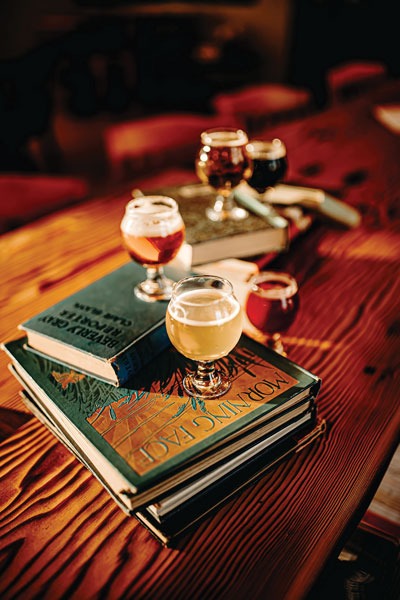
With such a unique building, Gibson and Kraus were determined to make the experience of visiting the brewery match. Filled with decor appropriate to the building’s past life, the taproom offers a relaxing atmosphere full of books, card catalogs, as well as furniture from the former library. Their 5-beer flight boards are old card catalog drawers (see photo below). Gibson focuses on uniqueness with the lineup of beer as well, avoiding the all-in-on-IPA approach, to offer a wide variety of classic beer styles.
“With 12 taps, we strive to offer many different beers,” Gibson says. “Our lineup includes mostly the classics, rather than trendy brews. We tend to gravitate towards the darker beers, whether ales or lagers, but we will try all styles. We appreciate something well-crafted. If it’s clean and well-brewed, any style can be great!”
As homebrewers, Gibson and Kraus had been fans of the Who’s in the Garden Grand Cru recipe from Charlie Papazian’s classic homebrew guide, The Complete Joy of Homebrewing, and began experimenting with their own riff on the recipe. As one of their favorite styles, they knew they had to bring a witbier to the taps at Second Chapter.

“When scaling and upgrading to the commercial side, we refined our recipe to be as true to a traditional witbier style as possible,” Gibson says. “Having both the orange peel and coriander up front and noticeable was intentional. The citrus and herbal aroma and flavor are what we think makes a good witbier.”

For the grain bill, Gibson feels that nailing down the proper ratio of wheat in the recipe adds a vital element of complexity, as well as a slight visual haze to the finished beer — a must for the style.
“Some brewers will use a combination of both malted and unmalted wheat, but in our research and recipe, we only use unmalted wheat,” says Gibson. “We believe it gives better flavor and body.”
Oats, Gibson adds, are a significant contributor to the profile of the beer as well, offering an important contribution to the mouthfeel. He falls into the camp that prefers malted oats over flaked for the style.
Finally, Gibson notes that finding quality orange peel is key to making this style shine. Orange peels can be either sweet or bitter. Which you prefer to use will come down to your own preferences in the end. Bitter orange peel contributes a more general citrus character to the beer and, of course, a slight amount of bitterness. Sweet orange peel, however, will add a more pronounced, intensely orange character. Bitter orange peel has classically been the choice for brewers when it comes to crafting a wit, but a brewer open to a bit of experimentation may find that they prefer to use a mix of both, combining the highlights of each approach.
Second Chapter Brewing’s Witty Librarian clone
(5 gallons/19 L, all-grain)
OG = 1.052 FG = 1.013
IBU = 14 SRM = 3 ABV = 5%
Ingredients
5 lbs. (2.3 kg) Pilsner malt
4.5 lbs. (2 kg) flaked wheat
1 lb. (0.45 kg) oat malt
0.5 lb. (230 g) rice hulls (optional)
4 AAU Hallertau hops (60 min.) (1 oz./28 g at 4% alpha acids)
1.5 oz. (43 g) fresh orange peel (5 min.)
0.4 oz. (11 g) coriander seed, crushed (5 min.)
Wyeast 3944 (Belgian Witbier), White Labs WLP400 (Belgian Wit Ale), or Mangrove Jack’s M21 (Belgian Wit) yeast
3⁄4 cup corn sugar (if priming)
Step by Step
If using a false bottom or manifold system for lautering, then the rice hulls are recommended. Start by placing the rice hulls into the mash tun first. While they will get mixed in with the crushed grains at mash-in, the goal is to have more of the rice hulls at the bottom of the mash tun.
With the goal of creating a dextrinous wort, mash in with 3 gallons (11.4 L) of 166 °F (74 °C) strike water to achieve a single infusion rest temperature of 153 °F (67 °C). Hold at this temperature for 60 minutes, then start the lauter process.
With sparge water at 170 °F (77 °C), collect about 6.25 gallons (24 L) of wort. At start of boil, add Hallertau hops, then boil for 60 minutes. With 5 minutes left in the boil, add fresh orange peel and crushed coriander.
Chill wort to fermentation temperature, around 66 °F (19 °C). Pitch yeast. Hold at this temperature for the duration of active fermentation. After final gravity is achieved, chill to 60 °F (16 °C) and allow to condition for one week. Bottle and prime or keg and force carbonate to 2.5 v/v.
Second Chapter Brewing’s Witty Librarian clone
(5 gallons/19 L, extract with grains)
OG = 1.052 FG = 1.013
IBU = 14 SRM = 4 ABV = 5%
Ingredients
6 lbs. (2.7 kg) dried wheat malt extract
0.5 lb. (230 g) Carafoam® malt
4 AAU Hallertau hops (60 min.) (1 oz./28 g at 4% alpha acids)
1.5 oz. (43 g) fresh orange peel (5 min.)
0.4 oz. (11 g) coriander seed, crushed (5 min.)
Wyeast 3944 (Belgian Witbier), White Labs WLP400 (Belgian Wit Ale), or Mangrove Jack’s M21 (Belgian Wit) yeast
3⁄4 cup corn sugar (if priming)
Step by Step
Steep the Carafoam® in a muslin bag in 2 gallons (8 L) of water at 152 °F (68 °C) for 30 minutes. Afterwards, place the grain bag in a colander and wash with 1 gallon (4 L) of warm or hot water. Add water to reach a total volume of 5 gallons (19 L).
Bring liquid to a boil, then turn off the heat and carefully stir in the dried malt extract. Once fully dissolved, bring wort back to a boil.
Add Hallertau hops and boil for a total of 60 minutes. With 5 minutes left in the boil, add fresh orange peel and coriander.
Chill wort to fermentation temperature, around 66 °F (19 °C). Pitch yeast, being sure to top off fermenter to 5.25 gallons (20 L). Follow all-grain recipe for fermentation and packaging instructions.
Tips For Success
When it comes to the spices, be sure that the coriander seeds are fresh. For the orange, use a vegetable peeler to remove just the outer layer of skin. There are several orange varieties that work like Seville, blood, navel, and cara cara, to name a few. Grab a peeler, a cheap macro lager, and try soaking the peels to see what works best for you.