Social Media for Nanobreweries
You didn’t get into brewing because you love making content. You got into it because you love making beer. So, here’s something that might surprise you coming from a marketing professional: Social media is not the most important marketing you’ll do for your beverage brand. It’s necessary, don’t get me wrong. It’s also mostly free, which is exactly why so many small breweries lean on it way too hard.
Here’s the big problem with building your whole plan on Instagram: It’s rented land. If Meta shut down tomorrow, how would you reach your fans? You don’t own your followers. You can’t contact them whenever you want. The platform decides who sees your posts, the algorithm changes overnight, and if your account gets hacked or suspended, good luck finding a human to help you. But don’t panic and start deleting your handles after this paragraph. What you want is a balance: Social media to build brand awareness, plus other channels that let you actually own your audience. You need both — so think of social media as your welcome mat, not your cash register. Its job isn’t to ring up sales; it’s to build community, put your brewery in people’s heads, and guide potential customers over to the channels you do own. Paired with email and a decent website, it becomes a real brand growth engine. Used alone, it’s a treadmill. Let’s talk about how to stop running in place.
Some Basics First
For the folks with no marketing background, let’s tackle some building blocks first. The term you’ll hear the most is “brand awareness.” As in, “I need to build brand awareness for my nanobrewery.” I have a marketing degree, and even I think most of this vocabulary is overcomplicated, so here’s the plain version. All “brand awareness” really means is how well people know and remember your brewery. Brand awareness leads to visits, and visits lead to revenue; it’s that simple. The first type of awareness is recognition. Picture this: Someone is scrolling their phone on the couch, your label or taproom flashes by, and their brain goes “hey, I know that place.” The second type of awareness is recall, and this one is the real moneymaker. A great example of recall is when people in a group chat are deciding where to go this Friday night, and someone mentions your brewery by name.
What this means for your social media content is that every post you make is a deposit towards one of those two moments. And you need both of these things, because people buy from brands they know, like, and trust. Social media is where a small brewery starts building all three through brand awareness.

Pick Your Channels Based on Who You’re Trying to Reach
Deciding where to post on social media should be based on the audience you’re trying to reach, not on which apps you happen to use personally. Every platform skews and performs differently. Instagram is your visual storefront for roughly the 25-to-45 crowd. Facebook still quietly drives event attendance, community groups, and the 40-plus market. TikTok and YouTube Shorts reach the under-30s who are still forming their brand loyalties. Even LinkedIn has a use if private events and distribution sales are a revenue stream for you. You don’t need them all. One or two channels with real attention behind them beats five neglected ones every time.
Social Media Is the New Search Engine
A big chunk of consumers, and more than half of Gen Z, now skip Google entirely and search directly on Instagram, TikTok, and YouTube. When someone new to town types “breweries near me with a patio,” your profile could be their search result (that’s what you want), so treat social media like a search engine. Put your city and neighborhood in your profile bio. Write captions with the words real customers actually use: “family friendly,” “dog friendly,” “live music,” “food truck,” your town’s name, and yes, beer styles too. Before you hit post, ask yourself: Is this something my customers would actually search for or talk about? Somebody searching “hazy IPA in [your city]” should land on you if that’s your thing. Hashtags work the same way; they’re keywords, not decoration or fancy marketing; they serve a purpose. Mix broad ones (#craftbeer, #hazyipa), local ones (#yourtownbeer), and specific ones like your brewery or beer names.
Don’t forget that occasions are searchable too. Your customers aren’t necessarily hunting for “West Coast-style IPA with Simcoe® hops and a 40 IBU finish.” They’re looking for a patio beer, somewhere to take the in-laws, a spot to wind down after kickball league night. So put the occasion right in the caption and hashtags: “post-trail pints” with #patioseason, or “date night, but make it flights” with #datenightideas. Talk about when and where your beer fits into their lives, not just what’s in the tank. Save the deep hop chemistry conversation for the beer nerds at the bar. We love them, but they’ve probably already found you; we’re trying to reach the customers that haven’t discovered you yet.
Quality Over Quantity, and Scrappy Beats Polished
The old social media advice was to post every day and feed the machine. Forget that; the algorithm has evolved since then. The platforms now reward content people actually engage with, which means one thoughtful post that starts conversations will outperform five throwaways. Posting less but posting better is a legitimate strategy, and for a lean team it makes perfect sense.
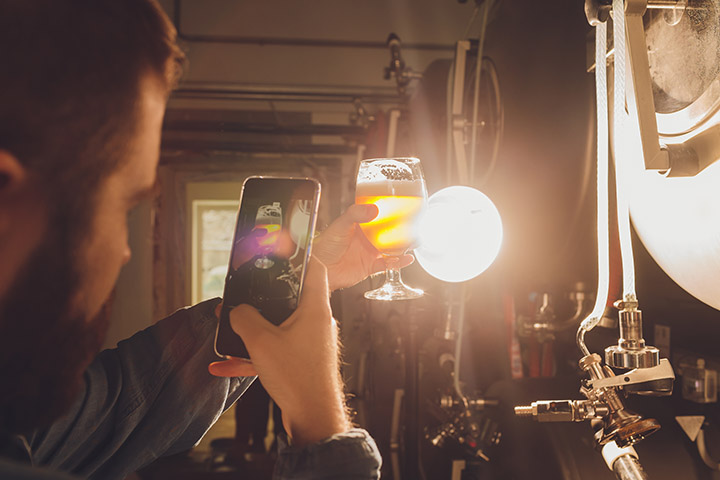
Now, “better” does not mean fancier. Short-form video keeps earning more reach than anything else you can post, and audiences have gotten very good at smelling stock photos, overproduced gloss, and “AI slop.” What stops the scroll is a real human doing a real brewery thing: You in your boots dry-hopping a tank or pulling the first pint of a new batch. You do visually interesting work every day that most businesses would kill for. Prop your phone against a bucket, film 20 seconds, talk like you’d talk to a customer at the bar, done. No editing, no polishing, just hit publish.

Not sure what to film? Short-form video tends to perform best when it hits one of four themes:
• Education: How to pour a proper pint, or what dry hopping actually does.
• Entertainment: The unglamorous reality of cleaning kegs, or your dog supervising the brew day.
• Inspiration: The story behind a recipe name, or your first janky setup next to what you run now.
• Social proof: A packed trivia night, or a stellar taproom or beer review.
And nobody needs acting lessons for any of this. If talking to a camera feels painful, shoot a time-lapse of a brew day and lay your own audio over it, or just capture the small, intimate tidbits of brewery life nobody else gets to see. Authentic beats scripted, every single time.
Conversations and Connection Beat Likes and Views
Repeat after me: Followers, likes, and views are vanity metrics. They feel good and give you that sweet shot of serotonin, but literally tell you almost nothing about whether your marketing is working. What actually matters — to the algorithm and your bottom line — is engagement: Comments, shares, saves, and direct messages. A like takes zero effort. A comment, a share, or a DM takes real effort, and effort (engagement) is what builds a bond with your brand. So build posts people can respond to: Ask questions, run polls, tell them to tag their friends. Give every post a job: Tag the friend you’d bring, vote in the comments, click the link to RSVP, subscribe through the link in our bio. If a post doesn’t ask your audience to do anything, they’ll do exactly that and keep scrolling.
Then show up in the conversation yourself, because engagement is something you do, not just something you collect. Follow this rule: You have to give what you want to get. Spend 5–10 minutes a day being a good digital neighbor. Reply to comments and DMs; most people now expect a response within a day, the same way they’d expect a bartender to acknowledge them at the rail. Comment on posts from the coffee shop down the street, your food truck partners, or the local run club. Their followers see your name pop up again and again, and recognition starts before anyone tastes a drop of your beer, and community is the key to success for beer brands and social media.
Every So Often, Point Them Towards Channels You Own
The social media “welcome mat” has a very important purpose: It leads people through the door. On social channels, that means occasionally steering followers toward your owned channels, where you can actually track a sale when it happens. Promote your email list with a real reason to join, like early access to releases or a birthday pint, and make signing up easy with a link in your bio and a QR code on the tables. Push event RSVPs to your website. If Instagram disappeared tomorrow, your email list and website are what’s left standing, so treat every social follower as a future subscriber and regular customer.
Doing All This in a Few Hours a Week
None of this matters if it doesn’t fit your actual bandwidth, so here’s my teacher-hat moment. Build a social media content bank. Decision fatigue can kill your consistency, so stop deciding from scratch every day. Keep a running list of themes: What’s on tap, behind the scenes, staff spotlights, the story behind a recipe name, upcoming events, how to pair or serve your beers, to-go options. When it’s time to post, pick from the list instead of staring at a blinking cursor. Using this system, you will post higher quality content and not feel so stressed about what to post.
Batch and schedule. Once or twice a month, sit down with a beer (quality control, obviously) and build a few weeks of posts in one sitting (start with one week — baby steps, my friends). Canva can help you edit photos and graphics, and a scheduler like Publer, Later, or Meta’s free Business Suite can publish while you’re mashing in or doing payroll. Plan about 80 percent of your content ahead of time and leave the rest for spontaneous, real moments. Snap a couple of photos or videos each week and dump them in a folder. Future you will say thank you.
Let Your Customers Do the Talking
A stranger trusts a customer’s photo or video of your full patio far more than they trust your marketing. So ask for it. Put a small sign by the register: Tag us, show us, get a sticker or a discounted flight. Repost every customer photo you’re tagged in; it costs nothing and makes that customer feel like a regular. This is called user-generated content and is a boss move for any emerging brand. Create a branded hashtag, print it on your menu, and let the community drive it in the algorithm. Do the same with Google reviews; the more the better, even the bad ones; bonus points for responding to reviews too, because the internet search engine bots love a good business listing with a lot of reviews and engagement.
Last Call
If you remember one thing, make it this: Social media was never designed to be your cash register, and the breweries that treat it like one end up frustrated, burned out, and convinced that marketing doesn’t work. I watch it happen every year. Marketing does work. It just works in a specific order: Pick the one or two channels where your people actually are, show up as your real, unpolished, unmistakable self, start conversations instead of collecting likes, and keep walking those followers toward the land you own; your email list, your website, and, ultimately, your taproom.
Further Reading . . .
• Social media is just one part of marketing your brewery. Should you be spending money on other marketing outlets? Get advice on a recommended marketing budget.