Trillium Brewing Co.’s Trillium clone
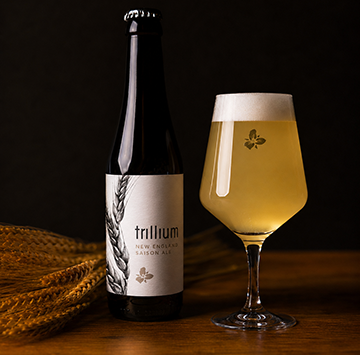
Trillium Brewing Co.’s Trillium clone, All-Grain
(5 gallons/19 L, all-grain)
OG = 1.047 FG = 1.000
IBU = 46 SRM = 3 ABV = 6.1%
This New England saison is one of Trillium’s earliest recipes and utilizes local ingredients, including corn grown at Trillium’s farm in North Stonington, Connecticut. Feel free to substitute ingredients local to you when brewing this recipe, though JC strongly recommends using Valley Malt’s Danko rye malt, which is less spicy than most rye malts used for brewing.
Ingredients
8 lbs. (3.6 kg) Valley Malt Pilsner malt
1.25 lbs. (0.6 kg) Valley Malt Organic Danko Rye malt
8 oz. (225 g) dent corn (milled into a powder)
10.8 AAU Sterling hops (first wort hop) (1.2 oz./34 g at 9% alpha acids)
0.5 oz. (14 g) Saaz hops (whirlpool)
1 g Whirlfloc (15 min.)
Wyeast 3724 (Belgian Saison), White Labs WLP565 (Belgian Saison I), or SafAle BE-134
1 cup corn sugar (if priming)
Step by step
The corn will require a cereal mash. Combine the corn and 1 lb. (0.45 kg) of Pilsner malt into a pot, mix well, and add 1.25 gallons (5 L) of 125 °F (52 °C) water. Slowly raise the temperature to 205 °F (96 °C), stirring regularly. Be careful not to allow the bottom to scorch. Rest at 205 °F (96 °C) for 60 minutes, stirring every 10 minutes or so.

The primary mash uses a “soft water” profile. If you have high total alkalinity or high mineral water, dilute back with reverse osmosis or distilled water. Add back small quantities of gypsum and chloride at a 3:1 ratio.
Combine the cereal mash with the main mash to hit a temperature of 142 °F (61 °C) and slowly raise to 162 °F (72 °C) over the course of 60 minutes. Alternatively, if you are unable to heat your mash tun, do a single-infusion mash at 146 °F (63 °C) for 60 minutes. Then stir in boiling water to bring the mash temperature back to 146 °F (63 °C) for another 30 minutes (for a total mash time of 90 minutes) to try to drive as much attenuation as possible.
Mash out and collect 6.5 gallons (24.5 L) of wort on top of the first wort hops in the kettle. Boil for 60 minutes, adding the Whirlfloc in the last 15 minutes.
When the boil is complete, adjust pH to 5.0 with lactic acid, if necessary. Chill wort to 180 °F (82 °C) and add the whirlpool hop addition. Stir wort to create a whirlpool and then allow to settle for 10 minutes before cooling wort to 72 °F (22 °C).
Pitch yeast and allow the fermentation to free rise quickly to the low 80s °F (upper 20s °C), then gradually climb to high 80s or low 90s °F (low 30s °C).
When fermentation is complete, rack off the yeast and (preferably) bottle condition in thick glass bottles to 3.5 volumes with dextrose (or force carbonate in a keg). Keep bottles at 85 °F (29 C) for three weeks. Be sure to use bottles capable of handling higher carbonation levels. Validate attenuation is complete before chilling bottles. Bottles should be kept in a fridge for at least a week before enjoying. Pour decisively in a tulip to allow enough room for the foam to rise and set.
Partial Mash Option:
Reduce the Pilsner malt to 2 lbs. (0.9 kg), eliminate the crushed corn, and add 3.3 lbs. (1.5 kg) Pilsner dried malt extract and 8 oz. (230 g) of flaked corn. Add the crushed malts and flaked maize to a large muslin bag and submerge in 5 quarts (5 L) of water to stabilize the mash at 151 °F (66 °C) and hold for 60 minutes. Remove the grain bag, rinse with water, and then top up the brew kettle to 6 gallons (23 L). Stir in malt extract until dissolved, and then bring to a boil for 60 minutes. Follow the remainder of the all-grain recipe.
Tips for Success:
Many rye malts will have too harsh a rye spice flavor. If not using Danko Rye, JC recommends reducing the rye to about 8 oz. (225 g) and making up the difference with Pilsner malt. Substituting flaked maize is an option if you cannot get finely milled dent corn in the all-grain recipe.
JC recommends pitching about half the cell count of a normal ale fermentation per degree Plato when using the Dupont strain. This strain is notorious for the “Dupont stall,” where fermentation appears to stop before reaching final gravity. The yeast should pick back up again if following the temperature increases laid out in the instructions. If you do not have a temperature-controlled chamber, try wrapping a blanket around the fermenter, using a heat pad, or other means. “Do whatever you need to keep the temperature going up. There’s a very long tail of attenuation, and if any kind of cooling happens, it’ll prevent the yeast from fully attenuating to 0 °Plato (1.000 SG). Sometimes it takes 10 days, sometimes 3+ weeks,” JC said.