Triptych Brewing Co.’s Luke’s Still Here, Man. clone
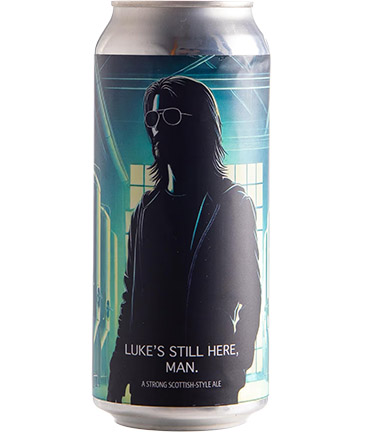
A dry wee heavy named after Triptych Brewing Co.’s brewer and fermented with a lager strain.
Triptych Brewing Co.’s Luke’s Still Here, Man. clone
(5 gallons/19 L, all-grain)
OG = 1.080 FG = 1.015
IBU = ~17 SRM = 16 ABV = 8.5%
Ingredients
8.5 lbs. (3.9 kg) Golden Promise malt
6.9 lbs. (3.1 kg) 2-row pale malt
11 oz. (310 g) CaraMunich® malt (60 °L)
6 oz. (170 g) pale chocolate malt
4.8 AAU Fuggle hops (first wort hop) (1.2 oz./34 g at 4% alpha acids)
1⁄2 tsp. Servomyces yeast nutrient (or other yeast nutrient that includes zinc)
Your favorite lager or clean-fermenting ale yeast
3⁄4 cup corn sugar (if priming)
Step by Step
Water Preparation: Begin with reverse osmosis water and build a target water profile of: Ca: 4 ppm, Mg: 4 ppm, SO4: 0 ppm, Cl: 10 ppm, HCO3: 45 ppm. Add enough calcium chloride to the mash and kettle to hit 50 ppm Ca and roughly 100 ppm chloride.

Mill the grains and mash in with 4.75 gallons (18 L) of strike water to achieve a single infusion rest temperature of 152 °F (67 °C). Hold at this temperature for about 60 minutes or until full conversion is achieved.
Add hops directly to the kettle for first wort hopping. With sparge water at 170 °F (77 °C), sparge and collect about 6.25 gallons (23.6 L) of wort in the kettle over the hops. Bring the wort to a boil.
At the start of the boil, set a timer for 60 minutes. With 15 minutes remaining in the boil, add Servomyces or other yeast nutrient that includes zinc.
After the boil, chill the wort to your chosen yeast’s preferred starting temperature (typically around 48–50 °F/9–10 °C if using a lager strain). Oxygenate the wort heavily to reach 15 ppm if using liquid yeast and then pitch yeast.
Maintain fermentation temperature within your chosen yeast’s preferred range. Monitor the gravity, and during roughly the final 30% of attenuation (around 1.034 SG), allow the temperature to free-rise to 65 °F (18 °C). Hold for 3–5 days, then lager for 2–3 weeks.
Add priming sugar and bottle condition or keg and force carbonate as usual.
Triptych Brewing Co.’s Luke’s Still Here, Man. clone
(5 gallons/19 L, extract with grains)
OG = 1.080 FG = 1.015
IBU = ~17 SRM = 16 ABV = 8.5%
Ingredients
10.5 lbs. (4.8 kg) Maris Otter liquid malt extract
11 oz. (310 g) CaraMunich® malt (60 °L)
6 oz. (170 g) pale chocolate malt
4.8 AAU Fuggle hops (first wort hop) (1.2 oz./34 g at 4% alpha acids)
1⁄2 tsp. Servomyces yeast nutrient (or other yeast nutrient that includes zinc)
Your favorite lager or clean-fermenting ale yeast
3⁄4 cup corn sugar (if priming)
Step by Step
Start with 5 gallons (19 L) of carbon-filtered or reverse osmosis water. Because malt extract already contains a concentrated mineral profile from the original mash, there is no need to add the calcium chloride used in the all-grain version.
Place the crushed specialty grains in a large muslin bag. Steep in 2 gallons (7.6 L) of water at 155–165 °F (68–74 °C) for 30 minutes. Remove the grain bag, placing it in a colander over the kettle, and gently rinse with 1 gallon (3.8 L) of hot water.
Add water to the kettle to reach a pre-boil volume of approximately 6 gallons (23 L) and add the hops at this time. Bring to a boil, then turn off the heat and carefully stir in the malt extract until fully dissolved.
Boil wort for 60 minutes. With 15 minutes remaining in the boil, add Servomyces or other yeast nutrient that includes zinc.
After the boil, chill the wort to your chosen yeast’s preferred starting temperature (typically around 48–50 °F/9–10 °C if using a lager strain). Oxygenate the wort heavily to reach 15 ppm if using liquid yeast and then pitch yeast.
Maintain fermentation temperature within your chosen yeast’s preferred range. Monitor the gravity, and during roughly the final 30% of attenuation (around 1.034 SG), allow the temperature to free-rise to 65 °F (18 °C). Hold for 3–5 days, then lager for 2–3 weeks.
Add priming sugar and bottle condition or keg and force carbonate as usual.