Adjust pH with Sauergut
Read any beer magazine, scroll social media beer buzzes, or check out the selection of beer specials at your local brewery and you will likely see something about lagers. The word on the street is that we are amid a lager surge! As a fan of lagers, I think this trend is long overdue, although it will be years before the huge IPA category is toppled from the top craft style category position. And when IPA loses its spot at the top, who knows what the next king of craft will be. Maybe lagers!
The current lager trend is shifting the focus of some brewers away from hops, yeast biotransformation, and haze towards topics like ester control, pressurized fermentation, spunding, clear beer, nuanced malt flavor, the use of mashing technique to control wort fermentability, water chemistry, and pH control. As brewers begin doing more homework related to German lager tradition, preparation to encounter unusual sounding techniques like drauflassen, vorschiessen, and sauergut is a good idea.
Oh, what a great time to be a technical brewing nerd! If you are a proud nerd like me, please spend a bit of time here exploring the interesting practice of making and using sauergut to adjust mash and wort pH.
While sauergut may appear related to the aftermath of quickly eating a plate of spicy chicken wings on an empty stomach, it’s actually a term used to describe biologically-produced lactic acid from wort that literally means “sour good.” In a nutshell, sauergut is unhopped wort that has been soured by lactic acid bacteria. Commercial breweries routinely using sauergut have a special propagation vessel designed to meet brewhouse demands of sour wort used in the mash and sometimes in the kettle. We’ll get more into the specifics later.

Why is sauergut a thing? The primary reason that sauergut is used by German brewers is adherence to the Reinheitsgebot — Bavaria’s beer purity law from 1516 that continues to guide brewing methods in, and outside of, Germany. Because the aim of the Reinheitsgebot was to control brewing inputs, anything added to beer had to originate from the ingredients used to produce wort. Sauergut falls into this category and acids produced outside of the brewing process using other methods fall outside of the category. You may be wondering about carbon dioxide used to carbonate beer; yep, that too must be naturally produced!
The key question from a brewing viewpoint is why add biologically produced acid to the process?
The Reinheitsgebot provides historical context and explains why sauergut is still used by German brewers who follow the Reinheitsgebot and market their beers accordingly. However, homebrewers are only bound to those guidelines by choice and few of us are brewing beers that completely comply with the Reinheitsgebot. I will be considering all options in the discussion that follows.
All biochemical and many inorganic chemical reactions are affected by pH. Indeed, it’s nearly impossible to name anything important to beer that pH does not influence. Given its influence on process and product, brewers require methods to control mash and wort pH throughout the brewhouse. And sauergut is one method.
Unlike strong acids — for example hydrochloric acid — organic acids such as lactic acid do not completely dissociate within the pH range around their pKa (defined soon). However, the lactic acid sold in homebrew stores is concentrated, the pH is ~2, and nearly 100% of the carboxylic acid groups are protonated. I will translate this into practical terms in a moment but do want to show a little chemistry to illustrate why lactic acid works well for brewing.

The following shows the equilibrium between lactic acid and the lactate ion:
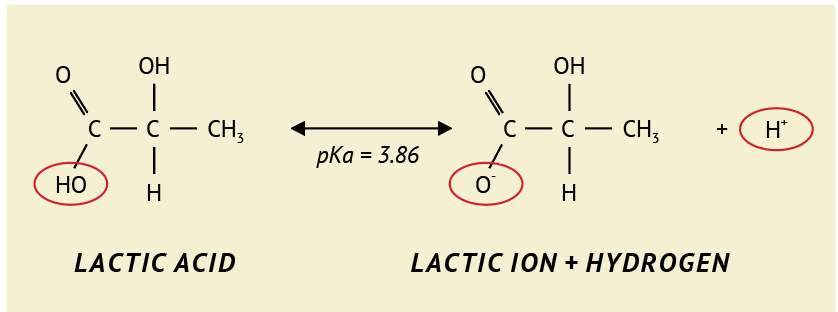
The pKa is the pH where an equal percentage of an organic acid group is in equilibrium with its so-called conjugate base. In the case of the lactic acid/lactate buffer system (the term used to describe mixtures of lactic acid and the lactate ion), lactic acid is the dominant species when pH is below 3.86; above pH 3.86, dissociation of the carboxylic acid group increases, and lactate becomes predominant.
Another useful illustration to provide a bit of context into the relevance of this to brewing is the dissociation curve below showing the percentages of lactic and lactate ion over the pH range from 0-8. These curves show how the lactic acid/lactate buffer system resists pH changes in the range from about pH 1.5 to 6.0 by having a non-linear equilibrium response in relation to pH. When hydrogen ions, generally thought of as “acid,” are added to lactate at pH above 6, some of those hydrogen ions attach to the COO- (carboxy group of the molecule) and do not lower pH and some of the hydrogen ions remain free, increase the overall concentration of hydrogen ions, and decrease pH. This is why a mixture of lactic acid and lactate molecules acts as a buffer, or dampening system, when acid or base is added (lactic acid behaves the same way when alkaline solutions are added).
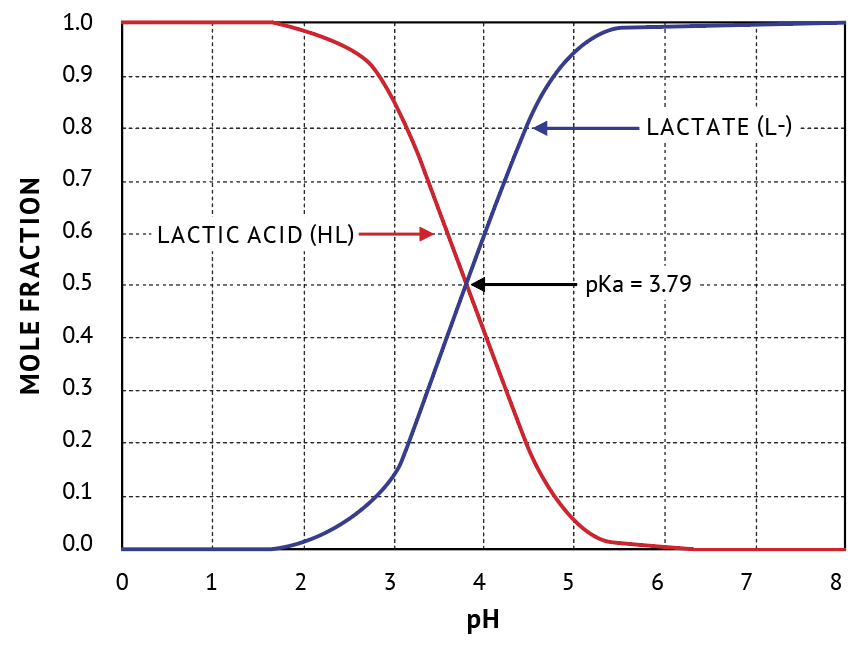
This general description is true of all pH buffer systems. Because the major brewing pH challenge is caused by water high in carbonates that push pH above the range best-suited for mashing and wort boiling, lactic acid is an ideal buffer for brewing where mash and wort pH is typically less than about 5.6 when measured at room temperature (68 °F/20 °C).
What does this all mean? For starters, adding concentrated lactic acid is not the same as adding sauergut. Although most of the “industrially produced” lactic acid in the world is produced using lactic acid bacteria, the dilute solution is treated with calcium and sulfuric acid to convert lactate into lactic acid by reducing the pH. In the process, calcium sulfate is removed, leaving behind high-purity lactic acid plus more hydrogen ions left over from the addition of sulfuric acid. The solution is then concentrated and packaged. This is distinctly different from a lactic acid buffer system like sauergut because there is no lactate present. When added to the mash, this concentrated lactic acid solution very quickly changes mash pH before the lactic acid buffer system begins to dial in.
In contrast, sauergut naturally contains a mixture of lactic acid and lactate because its pH slowly drops during souring. This buffer system is developing and controlling pH during sauergut production.
The same general comparison between sauergut and lactic acid can be made to other brewing acids like phosphoric, sulfuric, and hydrochloric. I decided to drop the last two on the list to draw attention to chemistry. The idea of adding hydrochloric acid (HCl) or sulfuric acid (H₂SO₄) to food can sound alarming, given how dangerous these strong acids are in concentrated form. In water, though, HCl simply dissociates into hydrogen and chloride ions, and H₂SO₄ into hydrogen and sulfate ions, none of which are unusual components of natural waters. Nonetheless, HCl and H₂SO₄ are not easy to use because of their potency and rapid pH changes following addition.
This discussion brings up one of the HUGE benefits to using sauergut at home; volume. Depending on water, mash, or wort volume and the magnitude of the pH tweak, concentrated acids, including lactic acid, may only require a few milliliters for pH adjustment. And because these acids are not buffer solutions, adding too much can quickly make the pH too low. Sauergut is both a buffer and a dilute solution, making usage easier because large volumes — typically 1% of mash volume and 1–2% of wort volume — are easier to measure and errors are less pronounced.
Another benefit of using sauergut instead of concentrated lactic acid is flavor. Although lactic acid and lactate are the primary products of wort souring, there are many other compounds present from the process. These other compounds are not present in concentrated lactic acid. The net results are subtle, but perceptible, flavor differences in finished beers brewed using sauergut. This is the same reason that kettle sours using a single, homofermentative lactic acid species, like Lactobacillus delbrueckii, often have a sharper acid edge and have less complex flavor profiles than sours made using a broader spectrum of bugs or heterofermentative lactic acid bacteria like Lactobacillus brevis and Lactobacillus plantarum (now named Lactiplantibacillus plantarum).
Fans of lager brewing techniques may be wondering how acidulated malt fits into this narrative. Unlike industrially produced acids, including concentrated and purified lactic acids, acidulated malt is typically Reinheitsgebot compliant. And German sauermalz, aka acidulated malt, are all Reinheitsgebot compliant because the purpose of these functional malts in Germany is convenient compliance. Although details surrounding sauermalz production are held close by German maltsters, it is known that these malts are acidified using sauergut. And like sauergut itself, benefits of sauermalz include lower concentration than liquid acids, Reinheitsgebot compliance, and round flavor profiles. The disadvantage to sauermalz from a homebrewing perspective is that there is no DIY involved in their use!
Making Sauergut
Making sauergut at home is very easy and requires little in the way of special equipment. When making a starter, which is how sauergut should be viewed, it is important to have a general idea of how much is required. A good rule of thumb is to have enough sauergut to add 60 mL/kg or 6 tsp./pound of malt. And when added to the kettle for wort pH adjustment, the upper end of the dosing range is about 120 mL/kg or 11 tsp./pound of malt used in the mash. Assuming we need enough for both uses, the total sauergut volume required for a standard 5-gallon/19-L batch is about 660 mL or 22 fluid ounces.
Commercially, sufficient sauergut from a single brew is drawn from the starter tank into a smaller vessel. During wort production, first wort at 1.074–1.083 SG (18–20 °Plato) is added back to the remaining sauergut to replace what was removed. The typical makeup volume equals the amount left in the tank. This allows the sauergut tank to function both as the propagator and as the source of the starter. Unless you brew very frequently — I’m looking at you, Denny Conn — and always use sauergut, this approach is generally not ideal.
A better home method is to grab wort from a lightly colored wort stream, adjust to about 1.036 SG (8 °Plato), freeze, and save for the future. About three days before your brew day, thaw your frozen wort, inoculate with 1-gram of finely milled malt per liter of wort, and put the starter in an incubator set to maintain a temperature at about 118 °F (48 °C). My MacGyver incubator is a cooler equipped with an incandescent light bulb plugged into the output of a temperature controller. I use the drain on the cooler to fish the temperature sensor and power supply wires into the bottom of the cooler. This requires terminating the light bulb power supply inside of the cooler and is easiest done using a simple, naked socket. This setup is perfect for making an incubator that can be used for sauergut, home yogurt making, or incubating chicken eggs if you have more than one hobby that requires an incubator.
Commercially, sauergut is often produced using pure bacteria sourced from a laboratory to provide more consistent performance. Kunze recommends using either Lactobacillus amylovorus or Lactobacillus amylolyticus (Technology Brewing & Malting).
Although the design of the propagation vessel, aka jar, is not important, excluding oxygen suppresses the growth of aerobic bacteria. If aerobic bacteria are allowed to grow, be prepared for unpleasant aromas and flavors to develop in your sauergut. Nicht gut! An airlock is required to produce clean-flavored sauergut. There are many options here and the best designs are those used to exclude air from pickle fermentations because these designs eliminate gas headspace. A zip-top bag filled with water makes for an effective and inexpensive airlock. Another option is a kimchi fermenter with a floating lid like fermenters produced by E-Jin.
Wort souring is self-controlling in that there is a limit to how much lactic acid bacteria can be produced before the products of fermentation stop acid production. If you start the process long enough in advance, it does not hurt to allow the process to run a bit long because sauergut is essentially an acid-preserved food product.
If this sounds interesting but too much work for a single brew, consider making a few liters of sauergut, splitting into ice cube-sized portions, and freezing for use. It’s best to store in an odor-impermeable container because freezers are a source of an array of stenches!
Using Sauergut
This leaves one topic to address: How much sauergut should be added? This is where beer nerds should close their Excel sheets, brewing software apps, or reference books and go to the bench. The only reliable way of dosing sauergut is to run a titration trial. A mash sample, magnetic stir bar, stir plate, pH meter, and a syringe, burette, or pipette are the required tools.
The mash sample is the one thing that makes the test a bit of a pain because you need to do this test before mashing-in your brew. 50 grams of finely milled malt plus 150 mL of hot brewing water makes for a good model system. If you plan to add brewing salts, you need to add those to the system. But if you have at least 50 ppm calcium in your water, no additional salts are needed. And you will be skipping any suggested additions of acid because that’s what the sauergut brings to the party. No belt and suspenders required!
The total dose will likely be less than 3.0 mL in the bench test, so it is important to set up your system where you can have both hands free. The best way to do this is to put the mash sample in a beaker containing the stir bar, position it on the stir plate, turn on the stirrer, wait until the temperature has dropped to room temperature, and insert the pH probe. It’s best to hold the probe in the middle of the sample. Unless you have something to hold the probe, it may be good to have a second set of hands for the titration.
You now want to slowly add sauergut until the pH drops to your target mash pH. Because a pH range is acceptable, consider adding 0.5 mL, waiting until the pH reading stabilizes, note the pH, and another 0.5 mL. Continue until you hit your desired pH or add more than required to get a feel for how linear or non-linear pH response is to sauergut addition. This is a great time to geek out and prepare a plot that you can whip out at a homebrew meeting or post to social media to show the world what a total brewing badass you are!
Sauergut is also useful if you want to adjust wort pH before wort boiling. This method can be used if your water is especially rich in carbonates and your wort pH is higher than you want before boiling begins. Consider using this when suppressing color development during wort boiling or if you want to check out the effects of lower boiling pH on the character of hop bitterness. However, it’s important to recognize that reducing wort pH decreases hop utilization and the rate of thermal decomposition of the Dimethyl Sulfide (DMS) precursor. In practice, this may mean that hopping rate is nudged up a hair and that boil duration may need to be extended for brewers who have pinched down their boil times. Another reason to add acid to wort prior to fermentation is to offset the raise in pH when high dry hop rates will be used. If this sounds interesting, read up on the relationship between hopping rate, beer pH, and beer flavor.
Whether looking for a link to the past, a new arrow to add to your brewing quiver, or a way to sharpen your lager game, sauergut is worth checking out. If you are new to sauergut and decide to dip your toe into the pool, please let us know how things went. We hope you experience no heart burn and appreciate the benefits of sour, good!
pH vs. Titratable Acidity — Why They’re Not the Same Thing
pH and titratable acidity (TA) both describe “acidity,” but they answer very different questions.
pH is a measure of the concentration of free hydrogen ions (H+) in solution. In brewing terms, pH influences enzyme activity in the mash, color and flavor development, hop utilization, and protein coagulation in the kettle, yeast performance, and flavor stability. When you target a mash pH of ~5.3 or a finished beer pH of ~4.4, you are managing process performance.
Titratable acidity tells you how much acid is present. TA is measured by slowly neutralizing the beer with base and recording how much is required to reach a set endpoint pH. Chemically, it reflects the total pool of acids and their conjugate bases, not just free H+. Sensory-wise, TA correlates more closely with perceived sourness and palate weight. It also is a metric of buffering capacity of a system. For example, the pH of two lactic acid buffers can be the same even when the two have different TA values. As TA increases, a buffer system is better able to resist pH changes when acid or base are added to the system.
Here’s a key brewing insight: Two beers can have the same pH but very different TA. A lightly acidified lager adjusted with lactic acid may hit pH 4.4 yet taste sharper than a sauergut-acidified beer at the same pH, because the latter contains more buffering material (lactate, phosphates, peptides). The same is true for sour beer styles, where different production methods may provide the same beer pH yet very different sensory profiles.
Check Out This Sauergut Video
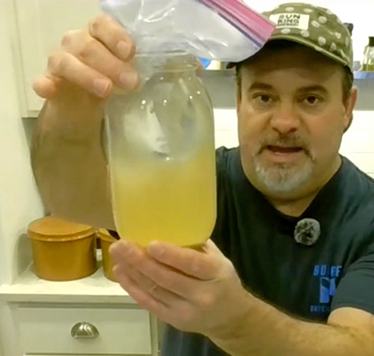
Want to see what Ashton is talking about? He recorded a BYO+ video about sauergut that you can watch as well.