Designing Homebrew Labels
Where do homebrew ideas come from? For most of us, it probably starts with: What do I want to drink? You pick a style of beer and start crafting your next brew. But as a homebrewer who’s also a professional graphic designer, I have a different starting point: What do I want the label to look like and say?
Over a decade of brewing under the Binko Brewing name, most of my beers begin as a design idea before I do any brewing. I’ll work up a concept and a name, which will lead me to the style of beer. I might be sitting on the couch or driving in the car when something comes into my head. Maybe I just watched a movie or ballgame, maybe I was talking with friends about a band I loved when I was younger — and from that comes an idea for a name and a label. And now I want to brew a beer!
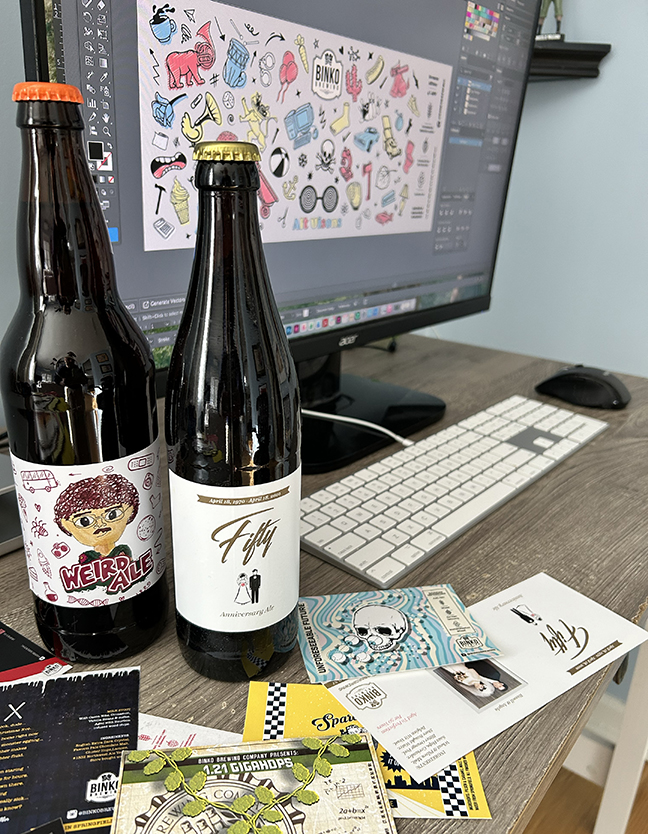
Label R&D
Right away, the blank canvas starts filling in a bit. I’ll do some research online: If it’s sports-related, what are the team colors and iconic images? If it’s a line from a movie, what’s the scene it comes from or a signature moment in the story? If it’s about a band, do they have a song title or a lyric that’s a good match for a style of beer? Am I brewing at a particular time of year or ahead of a holiday? I’m looking for anything that can inform a visual approach and let the drinker know what to expect in the bottle.
Once I have a decently clear picture in my head, that’s when my technical experience as a designer kicks in. The image on a label can’t just be anything — it needs to print and replicate well on a bottle-sized label. That means, in general, I try to stay away from photographs, which won’t look great when printed on a label. Instead, I’m using vector-based art, which is digital art made from points, lines, and curves that allows it to be scaled to any size without losing quality or
becoming pixelated.

For me, it’s a full-on R&D process that takes a week or two before grains and hops ever enter the picture. As a designer, I live in the world of Adobe software, so Photoshop, Illustrator, and InDesign are key tools in my homebrewing. These programs are available for download, however, there is a monthly fee involved. Honestly, any computer-based program you feel comfortable with will do the trick. Take advantage of free, license-free vector art sites, such as Adobe Stock (comes with your subscription) or Vecteezy to help with upgrading your graphics.
Another option if you don’t feel confident in doing the design yourself is using AI. Many artificial intelligence programs can create images of any size you ask. The more detailed prompts you give, the more personalized to you the label can become.
Fully blank, white adhesive labels that you can pick up at Staples was my “go-to” for many years. They work well, especially when printed on a laser printer. Any printer will do the trick, but if you are able to upgrade, the results will be more appealing. Be sure to not oversaturate your label with too many dark colors, especially black, as the results usually do not yield the
best print.
For the last five years or so, I have been using GrogTag to print my labels. GrogTag — as well as other label companies like Noontime Labels — makes label creation simple. It’s easy to upload a design, you don’t have to buy an obnoxious amount, the pricing is reasonable, and they only take a few days to arrive in the mail. Most importantly, GrogTag has predefined sizes, so if I know that I’m creating a label that’s going to go on a larger bottle, I’ll pick the full wrap option (7.375” x 3.125”) and just start designing on that canvas. Otherwise, you can run the risk of designing something cool that won’t work when it’s time to put it into a smaller or larger template that will screw up the whole thing.
Now, if I’m doing this design process at work, my colleagues and I might go through many, many versions of a design over days or even weeks. We’re trying to please a client and produce something for the professional marketplace. But homebrewing is supposed to be fun and relaxing, so I try to take the pressure off myself and keep it to three or four iterations until I’m happy with it. Sometimes I’ll ask another designer for some constructive criticism (in exchange for some beers, of course), and most of the time my wife and daughters will give me some feedback (no beer for the kids, though!). From start to finish on a Binko design, I’m definitely not stinting on quality, but I’m also not driving myself crazy.

What to Include On Your Labels
I believe that a beer label is basically a tiny resume, and I demand details! Right after the name, the beer style is non-negotiable. I’ve passed up countless mystery brews because I don’t want to accidentally crack open a “surprise kettle sour” when I was hoping for a stout. Listing the ABV, ingredients, or a short description is like giving me a gold star, but honestly, just save me from the existential dread of the unknown style.
Beyond that, consider how the label will look on the bottle or can. Look, your amazing 8-point font might look crisp on your 4K monitor, but the moment it hits that actual label, it transforms into an eye chart. I recommend sticking to 10-point type, minimum. If you insist on going smaller, print out your label first. If you have to squint or fetch a magnifying glass to read it, then the answer is no. Save yourself (and your friends) the inevitable headache. And stick to no more than a couple of different fonts on the label. A different font in the homebrewery logo, beer name, description, and details makes things look random. Uniformity with complementing fonts bring all of these pieces together.
Building Your (Homebrew) Brand
While labels are the essential starting point for your brand, expanding into other merchandise avenues is a fun way for increasing attention and notoriety if you like to share beers with friends, donate to charities, or just want to feel a little more professional in your hobby. Early on, I recognized this potential. I initially had Binko Brewing T-shirts printed as a Christmas gift for family and friends. To manage costs, I chose a basic blank (Gildan) and a simple, single-color print.
The shirts were an immediate success! I heard numerous stories from recipients about people inquiring how they could try Binko Brewing beer. Inspired by this organic marketing, I spent the next few years growing the merchandise line to include additional t-shirt and hoodie designs, hats, as well as branded glasses and stickers.
Six Select Binko Beers
To the extent that there’s a Binko “brand” for my labels, it’s a combination of simplicity and fun. The same goes for the beer inside the bottles, and I think over the years I’ve been able to pair the look and the taste in ways that I’m proud of — and happy to drink with friends and family.
During more than a decade of homebrewing and designing labels, I’ve made a lot of beers; here are a half-dozen highlights and a little bit about how I came up with the names and designs, in hopes they may inspire your own creativity.
1. Red
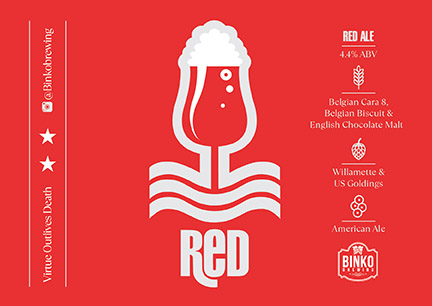
The U.K. football (y’know, soccer . . .) team I follow is Nottingham Forest, and their logo is a tree. Looking at their logo, I began thinking that it would be really cool if I could take the top of the tree, which kind of looks like beer foam, and make a hybrid beer glass image with the top of the tree as the foamy head. And the team’s nickname is The Reds . . . so it was pretty obvious that this would be a red ale. It all came together pretty quickly.
2. Fifty
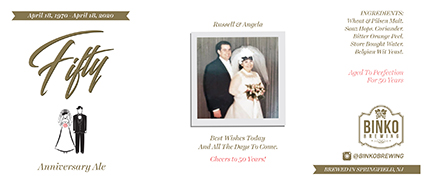
Right near the beginning of COVID, my parents were about to celebrate their 50th anniversary, and I wanted to do something special for them. We were originally going to have a party and I was going to bring their bespoke brew . . . but like everything else then, we had to cancel. But I now had plenty of extra time at home, so I wasn’t going to let the pandemic stop them from getting an anniversary beer!
I wanted to make a good beer that my mom would actually drink, and I remembered going on vacation one time when she had a Blue Moon and said, “This is pretty good!” So I brewed a witbier, and for the wedding theme made the label predominantly white. I worked up a little bride and groom icon based on an actual picture of my parents on their wedding day, and did the lettering in gold for their
golden anniversary.
I had to send them a few bottles, but we were able to celebrate together . . . over Zoom, of course.
3. A Mighty Long Way
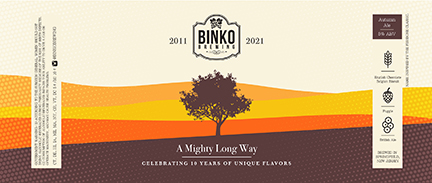
Speaking of anniversaries . . . this one marked the 10th anniversary of Binko Brewing! I love Fishbone, a punk-funk-soul-ska-whatever band from the 80s and 90s. I was trying to figure out a name for an anniversary brew and remembered the song “A Mighty Long Way” from their awesome Truth and Soul album. I wanted to keep the design simple, and while it was inspired by the band, I didn’t want it to be a “Fishbone beer.” An image of a single tree in the distance, a long way away, popped into my head, and the autumn anniversary date inspired the colors and the roasty brown ale style. I still can’t believe I’ve been brewing for more than 10 years!
4. 1.21 Gigahops
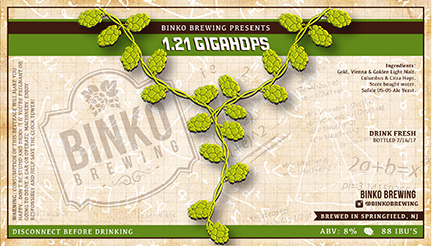
“Back to the Future” is a classic movie, and the reference to 1.21 gigawatts of electricity struck me as a great inspiration for a beer. I didn’t want the label to be super-obviously connected to the movie, so I figured out some little Easter egg references: The main image is hop bines, but they’re in the same Y shape as the flux capacitor; I scattered some math symbols in the background; I put in a fake IBU number, 88, referring to the 88 mph that the car needs to hit to travel through time; and the deposit return info says that the 5 cents will help save the clock tower. It was just me having fun with a favorite movie and seeing what I could fit into the small canvas of a beer bottle label.
5. Clyde Was Better Than Terry Porter
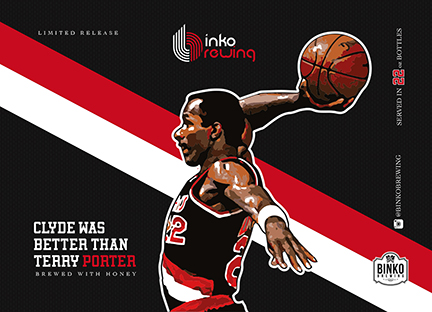
When I wanted to pay tribute to Clyde Drexler, one of my all-time favorite NBA players, I remembered that he’d had a teammate on the Portland Trailblazers named Terry Porter. Terry is a two-time NBA All-Star and the Blazers’ all-time assists leader. But to me, Clyde, an Olympic gold medal winner and 10-time NBA All-Star, was always the better Blazer . . . and my Clyde Was Better Than Terry Porter beer was born. The Blazers’ black/red/white uniforms gave me a color palette, and I sketched out a label with Clyde in action and the word “Porter” popping out in a contrasting color from the rest of the name. I flipped the “P” in the Portland Trial Blazers logo to look like a “b” for brand recognition. The kicker was that Clyde wore #22, so naturally, this was only offered in 22-oz. bottles!
6. Weird Ale
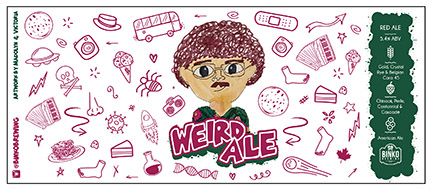
A recent highlight was Weird Ale, which was an opportunity to design a label with a couple of big fans of “Weird Al” Yankovic: My daughters. It was a truly awesome experience, start to finish. They’re the ones who came up with an initial drawing of Al, then we collaborated on the other label elements that refer to some of his hit songs, and I put it all together. The beer was a small-batch hoppy, red IPA.
Our collaborative work won the gold medal in the 2024 BYO Label Contest, which unexpectedly opened us up to the wider “Weird Al” community. Suddenly, a bunch of people were reaching out to me looking for a copy of the label, since a lot of fans are collectors of anything and everything “Weird Al”-related. Then I was approached by Ethan and Dave of the 2000” Weird Al Podcast. They asked if I would be interested in brewing a new batch and sending them a couple of bottles that they could give to “Weird Al” mentor and DJ Dr. Demento for his 84th birthday. They told me that Dr. D is a huge craft beer fan, so it was an honor to help them out with the gift. They took a pic with Dr. Demento and sent it to me, which I showed to my girls and posted on the Binko instagram account. The label led to a fun homebrew project and experience for our whole family!
My word of wisdom is simple: Have fun! As we always say at Binko Brewing, “The outside of the bottle is where the real magic is.”
Give me a follow @binkobrewing and DM me for any questions or if you ever want to collaborate!