Logboat Brewing Co.
Dear Replicator, On a recent road trip, my wife and I stopped at Logboat Brewing Co. in Columbia, Missouri. I was so happy to find a brewery with a mild ale on the menu! I’ve never been totally satisfied with my own attempts to brew low-ABV, malty beers like their Mamoot, so I’d love some tips for brewing something similar at home. Cheers!
David Haber
Chicago, Illinois
For many professional brewers, the journey to the brewhouse begins in the kitchen. For Josh Rein, Head Brewer at Columbia, Missouri’s Logboat Brewing Co., the love of cooking shaped his path even before he took up brewing. Rein found that homebrewing scratched the same creative itch as the culinary arts when he first started boiling wort with a friend back in 2003.
Rein’s brewing education took a major step forward in 2006 while living in Eugene, Oregon. A neighbor who had built an all-grain system out of old kegs offered to teach him advanced brewing techniques, and by 2009 Rein had taken his hobby to the professional level as an assistant brewer for a small pub. There, he honed his skills and gathered real-time feedback from patrons. In 2012, he connected with the owner-operators of Logboat Brewing (which had yet to open at the time), and by 2013 he was full-time — developing recipes, designing the brewery, and helping build out their space on Fay Street.

Over his brewing career, Rein has kept his focus on nailing down traditional styles and refining existing recipes. “I think it’s helped build a foundation that has helped maintain quality while experimenting with new flavor profiles and testing the limits of new styles,” he says.
As his approach to brewing has evolved, his recipes have actually become simpler. Adopting a ‘”less is more” mindset, Rein finds deep satisfaction in beers that exhibit layered complexity despite using only two types of malt and a single hop variety.
That philosophy still anchors Logboat’s lineup today. While they adapt to an evolving beverage market — recognizing the rise of non-alcoholic beers, canned “ready-to-drink” cocktails, and seltzers — Rein remains steadfast in his belief that there will always be a place for a finely crafted beer. Thus, Logboat attempts to maintain a balance across the range of modern preferences. Popular options on the taplist include their top-selling Snapper IPA (a 7.2% ABV West Coast IPA), with a core lineup steeped in classic traditions.
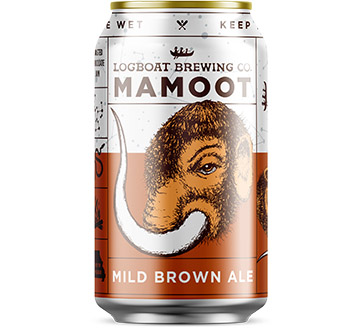
While IPAs may be the biggest sellers, it’s Logboat’s traditional, malt-forward styles that have garnered some of the brewery’s highest accolades. Logboat has been recognized at the World Beer Cup and Great American Beer Festival (GABF) for its lagers and dark ales such as Dark Matter Porter. Among them is Mamoot, a mild brown ale that holds the title of the brewery’s most awarded beer. Winner of a silver medal at the 2017 GABF, the brewery describes Mamoot as a “brown ale’s laid-back brother” and “a perfect breakfast beer.”
In an industry that’s still untangling itself from the “haze craze” of the past decade, Rein is optimistic about the cyclical nature of beer trends. With lagers making a strong mainstream comeback, Rein says he hopes to see the maltier side of beer — mild ales included — get their rightful recognition from the masses once again.

Mamoot began as a personal challenge for Rein’s homebrewery. “Mamoot was designed originally as an experiment in a low-alcohol beer,” he says. “Could I design and brew a full-flavored beer with 3.5% ABV? It took about three batches to get it dialed-in to where I liked it, and it was my house beer in the homebrewery for years before I had the chance to bring it to the market.”
Getting the recipe just right took several months, and Rein says that he focused on perfecting the mouthfeel and drawing out a specific toasted coffee note. “A lot of the trialing was using different caramel malts and layering them just right to get the balance I was looking for,” he says.
Once he brought the beer to Logboat, it became a day-one staple, and one of four beers in the brewery’s core lineup when it opened in 2014.
For homebrewers looking to replicate the subtle complexity of a beer like Mamoot, the key is always drinkability, Rein says. “I know it’s a buzzword, but it’s a simple way to describe a well-rounded beer. Perfectly balanced, subtly complex, and leaves you wanting another sip.”
To achieve that on a homebrew scale, Rein offers a few critical tips. First, he stresses proper, methodical cleanliness when it comes to brewing equipment, and an emphasis on sanitation at all stages, since flaws have nowhere to hide in lower-ABV styles.
Next, Rein recommends against taking any shortcuts with the yeast pitch rate in spite of the low ABV. “Pitch enough yeast to achieve a short lag time and quick primary fermentation,” he said.
Lastly, keep an eye on the fermentation temperature for a beer like this. “Fermentation temperature control is a must,” he says.
Logboat Brewing Co.’s Mamoot clone, All-Grain
(5 gallons/19 L, all-grain)
OG = 1.040 FG = 1.009
IBU = 10 SRM = 18 ABV = 4%
Ingredients
6.2 lbs. (2.8 kg) pale 2-row malt
13 oz. (360 g) brown malt
8 oz. (230 g) crystal malt (60 °L)
8 oz. (230 g) crystal malt (160 °L)
8 oz. (230 g) Simpsons Golden Naked Oats®
2.8 AAU Willamette Hops (60 min.) (0.5 oz./14 g at 5.5% alpha acids)
Wyeast 1028 (London Ale) or SafAle S-04 yeast
3⁄4 cup corn sugar (if priming)
Step by Step
With the goal of creating a moderately dextrinous wort, mash in with 2.75 gallons (10.4 L) of 164 °F (73 °C) strike water to achieve a single infusion rest temperature of 153 °F (67 °C). Hold at this temperature for 60 minutes.
Sparge with water at 170 °F (77 °C) to collect about 6 gallons (23 L) of wort in your brew kettle. Bring wort to a boil.
At the start of boil, set a timer for 60 minutes, then add hops.
When the boil is complete, chill wort to 64 °F (18 °C). Oxygenate if using liquid yeast and pitch yeast. When fermentation is complete, add priming sugar and bottle condition or keg and force carbonate.
Logboat Brewing Co.’s Mamoot clone, Extract with Grains
(5 gallons/19 L, extract with grains)
OG = 1.040 FG = 1.009
IBU = 10 SRM = 18 ABV = 4%
Ingredients
4 lbs. (1.8 kg) light liquid malt extract
12 oz. (340 g) crystal malt (60 °L)
12 oz. (340 g) crystal malt (160 °L)
8 oz. (230 g) Carafoam® malt2.8 AAU Willamette Hops (60 min.) (0.5 oz./14 g at 5.5% alpha acids)
Wyeast 1028 (London Ale) or SafAle S-04 yeast
3⁄4 cup corn sugar (if priming)
Step by Step
Place the crushed specialty grains in a large muslin bag. Steep in 2 gallons (7.6 L) of water as it heats to 165 °F (74 °C) for 30 minutes.
Remove the grain bag, placing it in a colander over the kettle, and gently rinse with 1 gallon (3.8 L) of warm water.
Add water to the kettle to reach a pre-boil volume of approximately 6 gallons (23 L). Bring to a boil, then turn off the heat and carefully stir in the malt extract until fully dissolved. Return to heat and boil for 60 minutes, adding hops at the start of the boil.
After boil, chill wort to 64 °F (18 °C). Oxygenate if using liquid yeast and pitch yeast. When fermentation is complete, add priming sugar and bottle condition or keg and force carbonate.
Tips for success:
Logboat Head Brewer Josh Rein stresses the importance of pitching plenty of healthy yeast and maintaining the proper fermentation temperature to achieve a quick fermentation and minimize the lag time.
More from Logboat
Logboat has also shared a recipe for their Shark Vista Flyer — the fifth iteration of their rotating IPA Rocket Shark Series featuring Vista hops.