The Flavor Network Behind Your Best Brews
Ever wonder why some ingredient combinations just work while others fall flat? Or why beer seems to play nice with almost any flavor you throw at it?
Researchers led by Albert-László Barabási at Northeastern University mapped the mathematical reason — 56,498 recipes, 381 ingredients, and one surprising discovery: Beer occupies a sweet spot in the global flavor network that makes it uniquely suited for creative brewing. Understanding this network logic can help you design better recipes.
Through this article, I’m going to explain what the scientists found in their research and how to use it in your next brew. But first, a note on the science and the author:
I’m Antal Németh, founder of MONYO Brewing in Budapest, Hungary. I have spent more than a decade as a professional brewer, and just as long teaching homebrewing workshops and writing about beer science. My background is in adult education, working as a university researcher and lecturer, so translating peer-reviewed science into something actually useful, rather than just cited, is what I do.

When I first encountered Barabási’s flavor network research, I built a custom analysis tool using the published dataset directly. The network measurements and ingredient connections cited in this article come from that analysis of the publicly available dataset (Ahn, Ahnert, Bagrow & Barabási, Scientific Reports, 2011). The brewing applications and recipe strategies are my own interpretations of how these principles translate to the brewhouse.
The Flavor Network Discovery
Ahn, Ahnert, Bagrow, and Barabási’s team at Northeastern University did something fascinating: They mapped how every culinary ingredient connects through shared flavor compounds. Think of it like a molecular compatibility map — ingredients that share flavor molecules tend to pair well together.
When they analyzed beer specifically, something remarkable emerged. Beer connects to ingredients across more flavor categories than any other alcoholic beverage in the network — bridging grains, fruits, botanicals, dairy, and fermented foods simultaneously. But it wasn’t just about quantity. Beer’s real advantage was where those connections led.
The network revealed that beer bridges multiple ingredient categories simultaneously — grains, fruits, spices, dairy products, and roasted ingredients. It connects to citrus through hop terpenes, to chocolate through malt pyrazines, to cheese through fermentation compounds. This multi-directional connectivity is what network scientists call a “bridge position,” and beer scores 0.634 on a 0-to-1 scale (where 1 would be a perfect universal connector), based analysis of the published dataset.
What caught my attention: When looking at these network properties together — connections, bridge positioning, and category flexibility — beer consistently scored higher than other fermentable bases. Not because we wanted it to, but because the math kept saying so.

Let’s make this practical.
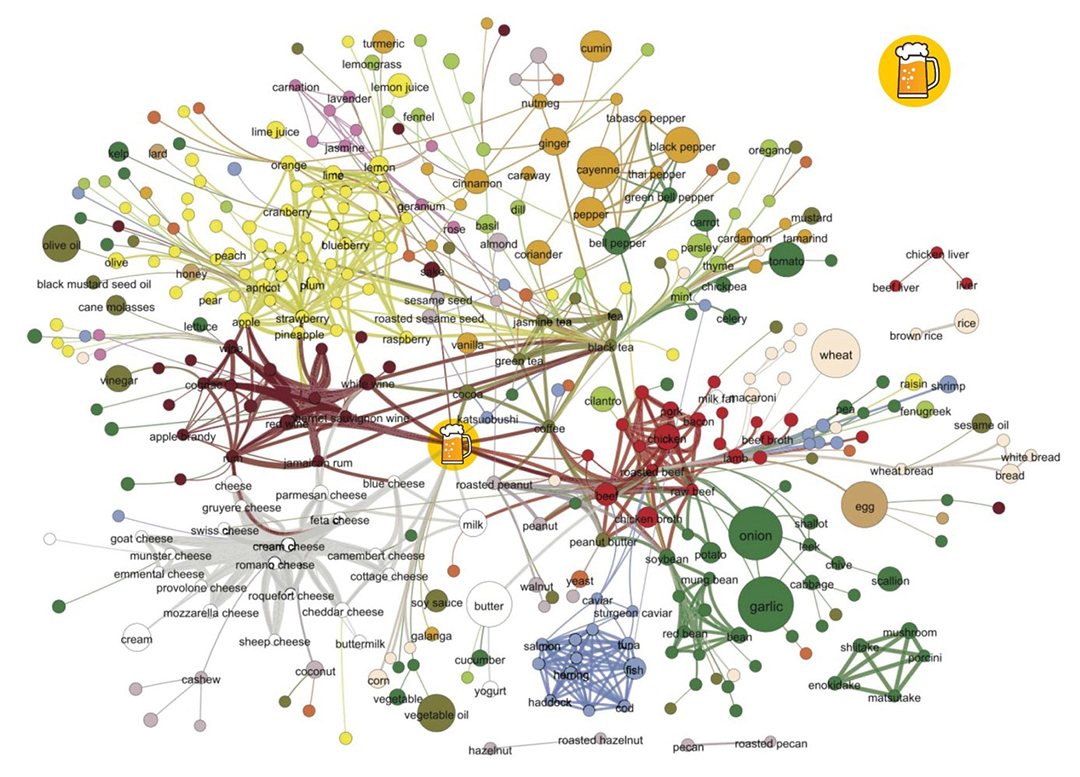
Each circle in the flavor network represents a culinary ingredient; circle size reflects how frequently it appears in recipes. Two ingredients are connected by a line if they share a statistically significant number of flavor compounds — the thicker the line, the more compounds they share. Colors indicate food category. Alcoholic beverages (dark red cluster, center-left) sit at a crossroads between fruits, dairy, meats, and botanicals — visually reflecting their role as flavor bridges. Beer is highlighted within the alcoholic beverages cluster. Figure courtesy of Scientific Reports.
Why Your Best Experimental Brews Actually Worked
Example 1: That Surprisingly Good Strawberry Wheat
If you’ve ever brewed a strawberry wheat and been surprised at how naturally it worked, network science has an explanation. (And if you have not, listen up because you may want to give it a try!)
Wheat is a common base for fruit beers, in part because it ferments dry, leaving little residual sweetness to compete with fruit aromatics. But here’s the network part: Wheat shares 44 flavor compounds with strawberry — the highest overlap of any common fruit, based on my analysis of the published dataset.
Try this: Next time you brew a fruited wheat beer, consider the fruit’s network compatibility:
Strong overlap (25+ compounds): Strawberry, raspberry, mango, blackberry → fruit amplifies the base
Medium overlap (15–24 compounds): Blueberry, apricot, peach, orange → fruit adds dimension
Lower overlap (under 15 compounds): Cherry, lime → deliberate contrast, use intentionally
Example 2: The New England IPA Fruit Addition Secret
Ever wonder why so many New England IPAs include fruit additions? It’s not just trend-hopping (pun intended) — it’s network logic.
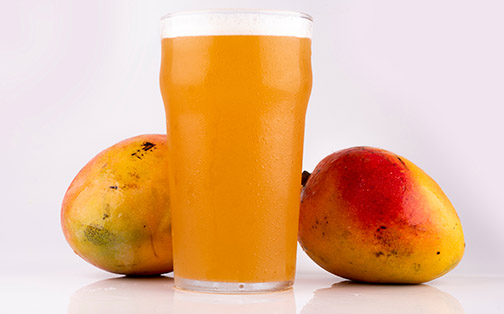
Modern American hops like Citra® and Mosaic® share 15+ flavor compounds with tropical fruits. When you add mango to a Citra®-hopped NEIPA, you’re not introducing foreign flavors — you’re amplifying what’s already there. The specific bridge comes from thiols — aromatic compounds that Citra® and Mosaic® produce in unusual abundance, and that are found in the same tropical fruits.
Recipe idea: Network-Amplified NEIPA
Grain Bill:
85% 2-row pale malt
10% flaked oats (texture bridge)
5% white wheat malt (haze stability)
Hops:
Citra®: 2 oz. (56 g) whirlpool (170°F), 2 oz. (56 g) dry hop day 3
Mosaic®: 1 oz. (28 g) whirlpool (170°F), 1 oz. (28 g) dry hop day 3
Fruit Addition:
2 lbs. (0.9 kg) mango purée, added on day 5 of fermentation.
Yeast:
Wyeast 1318 (London Ale III)
Fermentation Temperature:
68 °F (20 °C) (fruit flavor complements the NEIPA character and promotes haze)
The network logic: Upon closer review of the dataset, mangos share 36 flavor compounds with hops (and passion fruit shares the same number). You’re not adding complexity with the mango addition, you’re adding clarity to the tropical character already found in the beer.
Pro tip: This is why passion fruit works brilliantly in IPAs — it mirrors mango’s overlap almost exactly. Coconut behaves differently: Its flavor profile is dominated by lactones, a compound family that sits outside the terpene-driven hop-fruit continuum. The network confirms the intuition: Coconut feels like a different conversation.
Example 3: The Brown Ale That Became Something Special
Brown ales are classic, but let’s be honest, they can be boring (this isn’t just my opinion — how many trendy breweries do you know with a brown ale in regular rotation?). Here is a network-approved upgrade that will transform a standard brown into a dessert-worthy experience.
The Traditional Problem: Brown ales have lovely biscuit-toffee malt character to them, but they often lack a “wow” factor.
The Network Solution: Look at what brown ale malts naturally connect to — caramel, nuts, vanilla. These aren’t random; they share Maillard reaction products from the kilning process.
Recipe idea: Hazelnut Vanilla Brown Ale
Grain Bill:
75% Maris Otter malt
10% Munich malt (amplifies maltiness)
8% crystal malt (60 °L) (caramel bridge)
5% Victory® malt (biscuit, toasted)
2% chocolate malt (color, subtle roast)
Hops (low-key, supporting):
1 oz. (28 g) Fuggle 60 min. (18 IBU)
Additions:
4 oz. (120 mL) hazelnut extract at flameout (or 1 lb./0.45 kg toasted hazelnuts in secondary, 5 days)
2 vanilla beans split, added post-fermentation
Yeast:
LalBrew Nottingham
Fermentation Temperature:
65 °F (18 °C) (clean, allows malt/adjuncts to shine)
The network logic: Victory® malt shares Maillard-derived compounds with toasted hazelnuts — both develop their character through the same roasting chemistry. Vanilla shares vanillin with oak-aged character in crystal malts. The combination creates a “dessert bridge” without a sweetness overload.
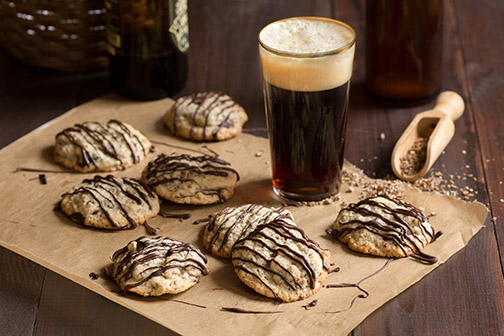
Serving suggestion: Pair with hazelnut biscotti — the network math predicts the pairing will be exceptional.
Quick Network Hacks (sidebar)
High-Connection Ingredients (use as versatile bases)
Beer (187 connections)
Wheat (89 connections)
Vanilla (76 connections)
Honey (51 connections)
Bridge Ingredients (connect distant flavors)
Vanilla (dessert ↔ spice ↔ fruit)
Honey (sweet ↔ floral ↔ fermented)
Coriander (citrus ↔ spice ↔ grain)
Amplifiers (boost existing character)
Mango + Citra® hops (18 shared)
Chocolate + roasted malt (18 shared)
Orange + hefeweizen or witbier yeast (25 shared)
Contrast Creators (deliberate tension)
Salt + anything (0–2 shared, use for enhancement)
Hot peppers + malt (3–4 shared, use sparingly)
Smoke + fruit (2–5 shared, creates complexity)
The Bridge Ingredient Strategy
Here’s where it gets powerful: Some ingredients act as bridges between distant flavor territories. Understanding these allows you to create combinations that seem weird on paper but work brilliantly in practice.
Case Study: Coffee Vanilla Orange Stout
Coffee and orange sounds like a bizarre pairing. But watch this:
Without a bridge:
Coffee ↔ Orange: Only 3 shared compounds
Result: Muddy, confused
With a bridge:
Coffee ↔ Vanilla ↔ Orange
Vanilla shares 18 compounds with coffee (both roasted/fermented)
Vanilla shares 12 compounds with orange (floral/sweet esters)
Result: Harmonious complexity
Mini-recipe for 5 gallons (19 L):
Base:
Your favorite imperial stout.
Additions:
8 oz. (235 mL) cold-brew coffee concentrate (at packaging)
Zest of 2 oranges (10 min., boil)
3 vanilla beans split (secondary, 5 days)
The vanilla acts as a translator between coffee’s roasted character and orange’s bright citrus. Without it, they fight. With it, they dance.
Network Hacks for Recipe Design
Amplify, Don’t Invent
When adding adjuncts, choose ingredients sharing compounds with your base. Chocolate in stout (18 shared compounds) amplifies roast character. Coconut (4 shared) creates contrast — use sparingly unless contrast is your goal.
Check Your Hop-Fruit Math
Before buying expensive fruit purée, check if your hops already have those aromatics:
Citra® + mango = redundant (18 overlap) → use mango to amplify
Hallertau + mango = complementary (3 overlap) → use mango to add dimension
Use Fermentation as a Bridge
Farmhouse yeast creates phenolic and ester compounds that connect distant flavors:
Saison yeast + black pepper + lemon: The yeast bridges the spice (phenols) and citrus (esters)
Result: Natural integration
Low-Overlap Can Be Beautiful
Sometimes you want contrast. Gose (salt + coriander + citrus) works because salt has minimal flavor overlap — it enhances rather than blends. Know when you’re seeking harmony vs. contrast.
Try These Network-Approved Harmonious Combinations (10+ shared compounds):
Hefeweizen + apricot + coriander
Wheat beer’s ester profile shares compounds with stone fruits. Coriander bridges the citrus notes from hefeweizen yeast. Classic German pairing, validated by network math.
Belgian blond + honey + orange peel
Honey shares fermentation-derived compounds with Belgian yeast. Orange peel connects through citrus esters. The result is easy-drinking with a complex aroma.
Creative Contrast (3–6 shared compounds):
Smoked porter + chipotle + chocolate
Chipotle brings two powerful dimensions at once: Smoke and heat. Chocolate bridges both — it shares
Maillard-derived compounds with the roasted malt base, and capsaicin-adjacent character with the pepper. The danger isn’t the network compatibility; it’s intensity. Start with one dried chipotle in 5 gallons (19 L), taste, add more if needed.
Pilsner + chamomile + honey
This low-overlap combination creates delicate layering. Chamomile: 1 oz. (28 g) steeped at flameout, 5 min. Honey: 8 oz. (230 g) at high kräusen (fermentable character, not sweetness).
The Cultural Bridge Discovery
Here’s something fascinating from the research: Western cuisines average 11.7 shared flavor compounds in their recipes. Eastern cuisines average 6.2. While Western cuisines emphasize complementary flavors, Eastern dishes emphasize contrast (based on my analysis of the published dataset).
Beer averages 9.4 shared compounds with typical ingredient pairings — right in the middle. This “bridge position” between Eastern and Western flavor philosophies helps explain beer’s global appeal and adaptability.
Practical application: When designing fusion-style beers (Asian-inspired, Latin American, etc.), beer’s middle position makes it naturally suited to bridge those traditions.
Example: Sake-yeast saison with yuzu and jasmine.
Western structure (saison), Eastern ingredients. Beer’s network flexibility accommodates both philosophies. Use sake yeast (Wyeast 4134) at 68 °F (20 °C), add yuzu zest at flameout, jasmine tea in secondary.
What This Means for Your Brewing
The craft brewing revolution wasn’t an accident. Beer’s network position — 187 connections, strong bridge score, balanced between culinary traditions — created what we might call an “optimal innovation zone.” Knowing that, how should you go forward using this to your advantage? Here are three things to try in your next brew:
1. Map Before You Brew
Before adding that exotic ingredient, ask: “Does this share compounds with my base, or am I creating deliberate contrast?” Both are valid, just know which you’re doing and do it
with purpose.
2. Use Bridges for Weird Ideas
Got a wild flavor combination in mind? Find a bridge ingredient. Vanilla, honey, and certain spices (coriander, cardamom) are high-bridge ingredients that can make unlikely pairs work.
3. Trust the Network
When a combination seems like it should work but you’re not sure, look for shared compounds. If they share 8+ compounds, give it a shot. If they share just one or two, find a bridge or approach carefully (or embrace the contrast intentionally).
The Math That Made Sense of Everything
Looking back at decades of brewing innovation — fruit IPAs, pastry stouts, dessert sours — the network data explains patterns we’ve seen but couldn’t articulate. Beer doesn’t just allow creativity; its molecular structure actively supports it. That’s not marketing speak. That’s mathematics.
The next time someone asks why you’re adding something unusual to a beer, you can tell them: “It’s not crazy — it’s network science.” Then hand them a glass and let the shared compounds speak for themselves.
Want to go deeper? The original research (Ahn et al., Scientific Reports 1:196, 2011) can be viewed online here. For an interactive ingredient lookup tool, visit the online public flavor compound database here.
But more importantly: Get brewing. The best way to understand network logic is to test it. Try the combinations suggested in this story or find your own, track what works, and develop your own network intuition.
The math says beer is the ultimate recipe playground. As a homebrewer, your job is to play.
Troubleshooting with Network Logic
Problem: “My fruit beer tastes muddy/confused”
Network diagnosis: You likely chose low-overlap fruit (3–5 shared compounds) without a bridge ingredient.
Fix: Add vanilla or honey as a mediator, or reduce fruit quantity and treat it as accent.
Problem: “The adjuncts disappeared in fermentation”
Network diagnosis: You added them too early; volatile aromatics were scrubbed by CO₂.
Fix: Add high-overlap adjuncts (amplifiers) late in fermentation or at packaging; add low-overlap adjuncts (contrast) even later.
Problem: “My spiced beer is overwhelming”
Network diagnosis: Spices are low-connection ingredients — a little goes a long way.
Fix: Use spices at 20–30% of what recipes suggest, especially if they’re low-overlap with your base.
Problem: “Everything tastes the same/boring”
Network diagnosis: You’re only using high-overlap combinations (harmony without tension).
Fix: Intentionally add one low-overlap ingredient (3–5 shared) for complexity.
Try Brewing With Different Ingredients
Ready to experiment with some different flavors? Here are some articles to help guide you on your journey.
Brew Award-Winning Fruit Beers