
Using ALDC to prevent diacetyl
Q. I recently watched your video on controlling diacetyl. Would it be a good idea to just use ALDC in your cooled down wort as a “normal” everyday ingredient when you add your yeast?
Rick Bray
Omaha, Nebraska
Mr. Wizard says…
A. I’ll start with a summary for those who aren’t familiar with alpha-acetolactate decarboxylase (ALDC). This enzyme is added to wort with yeast for one purpose: Converting the diacetyl precursor, alpha-acetolactate, into acetoin during fermentation. It’s also commonly added to beer a second time during heavy dry-hop additions because hop creep often triggers another fermentation phase in which diacetyl spikes. These ALDC additions essentially eliminate the need for a diacetyl rest and the worry of buttery beers.
The short answer to your question is EZ-PZ: If you want a hard stop on the possibility of yeast-related diacetyl in your finished beer, ALDC is the answer. But there is a “but.” Some brewers worry that hitting the Easy Button on diacetyl bypasses processes that slower, more traditional aging naturally resolves. What follows is an expansion of this answer, starting from the beginning.
During normal fermentation, yeast cells process wort components to synthesize essential compounds required for cell division, energy production, and all the intercellular goo and glue of life. One compound synthesized by yeast is alpha-acetolactate. This biochemical intermediate — typically used for valine synthesis — is secreted when metabolic processes back up. Outside the cell, alpha-acetolactate is chemically oxidized, carbon dioxide splits off, and diacetyl remains. And this is why some beers smell like butter.

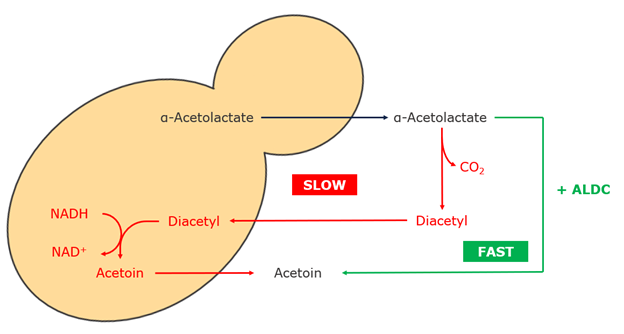
During traditional aging, diacetyl is absorbed by hungry yeast cells as a source of energy. Biochemically, diacetyl acts as a hydrogen acceptor and a metabolic restorer of NAD+, which is vital to the continuation of many enzymatic reactions. In the process, diacetyl is transformed into acetoin with a much higher flavor threshold (odorless unless the concentration is very high), and acetoin is excreted from the cell. Whether we’re talking about lagering, kräusening, or cask conditioning as benchmarks for traditional aging, all are relatively slow. That slowness differentiates them from the accelerated approach many brewers take when using ALDC.
But there is much more to beer aging than diacetyl reduction. Acetaldehyde — another intermediate expelled when biochemical traffic backs up — is also reduced by yeast and converted to ethanol. When left in beer, acetaldehyde contributes green apple, pumpkin/squash, and latex-like aromas. For what it’s worth, I am better able to detect acetaldehyde when thinking about the smell of latex paint because there is rarely a beer where I associate acetaldehyde with green apple or pumpkin/squash.
Yeast and haze-particle sedimentation, flavor integration, and natural carbonation are additional changes that occur during aging. While ALDC can shorten total aging time, there are benefits to longer conditioning, and this is why some brewers view ALDC as something that may solve one problem while potentially opening the door to others.
This answer could have gone in a completely different direction if your question had been about bioengineered yeast strains. There are yeast strains available today that have had a gene deleted, preventing them from excreting α-acetolactate. These are known as DKO, or diacetyl knock-out, strains. Other strains have been modified to synthesize and excrete ALDC.
In practical terms, these options highlight the importance of diacetyl-free beer to commercial breweries, since consumers generally don’t like buttery beers, and brewers know that diacetyl is filling and reduces drinkability.