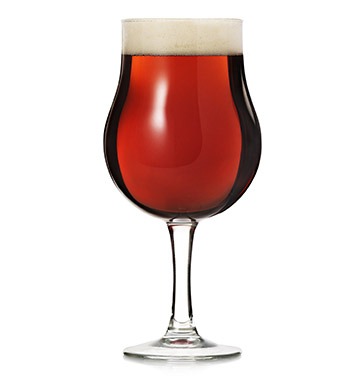
Tropical Stout
As a stout, tropical stout should be quite dark in color, in the very deep brown to black range, with a medium-full to full body. Since the alcohol is above average in strength (5.5% to 8%, sometimes slightly more), the beer can have a warming feel to it.
(5 gallons/19 L, all-grain)
OG = 1.071 FG = 1.016
IBU = 30 SRM = 56 ABV = 7.5% I chose to balance this beer on the strong and sweet side of the style, so I’m shooting for an ABV of about 7.5%. The sweetness comes more from low bittering (30 IBUs) than from a high final gravity or the addition of lactose or any other sweetener.
Ingredients
10 lbs. (4.5 kg) Golden Promise pale ale malt
12 oz. (340 g) UK roasted barley
8 oz. (227 g) UK extra dark crystal (160 °L)
8 oz. (227 g) Carafa® Special III malt
4 oz. (113 g) UK chocolate malt
4 oz. (113 g) Belgian Special B malt
1.5 lbs. (0.68 kg) turbinado or other unrefined sugar (15 min.)
9 AAU UK Golding hops (60 min.)(1.5 oz./43 g at 6% alpha acids)
Wyeast 2124 (Bohemian Lager) or White Labs WLP830 (German Lager) or Mangrove Jack’s M84 (Bohemian Lager) yeast
3⁄4 cup corn sugar (if priming)
Step by Step
Two or three days before brew day, make a 2-qt. (2-L) yeast starter, aerating the wort thoroughly (preferably with oxygen) before pitching the yeast.

On brew day, prepare your ingredients; mill the grain, measure your hops, and prepare your water. This recipe uses reverse osmosis (RO) water. Add 1⁄4 tsp 10% phosphoric acid per 5 gallons (19 L) of brewing water, or until water measures pH 5.5 at room temperature. Add 1 tsp. calcium chloride (CaCl2) to the mash.
On brew day, mash in the pale ale malt at 152 °F (67 °C) in 18 qts. (17 L) of water, and hold this temperature for 60 minutes. Raise the temperature by infusion or direct heating to 158 °F (70 °C) for 15 minutes. Finally, raise to 168 °F (76 °C)to mashout. Add the remaining malts, and recirculate for 20 minutes. Fly sparge with 168 °F (76 °C) water until 6.5 gallons (25 L) of wort is collected.
Boil the wort for 90 minutes, adding the hops at times indicated in the recipe. The sugar is added directly to the boil with 15 minutes remaining. Chill to 59 °F (15 °C). Oxygenate the wort, then pitch the yeast starter. Ferment at 59 °F (15 °C) until fermentation is complete. Rack the beer and lager at 32 °F (0 °C) for 3 weeks. Prime and bottle condition, or keg and force carbonate to 2.5 volumes.
Tropical Stout
(5 gallons/19 L, extract with grains)
OG = 1.071 FG = 1.016
IBU = 30 SRM = 56 ABV = 7.5%
Ingredients
6.6 lbs. (3 kg) light liquid malt extract
12 oz. (340 g) UK roasted barley
8 oz. (227 g) UK extra dark crystal (160 °L)
8 oz. (227 g) Carafa® Special III malt
4 oz. (113 g) UK chocolate malt
4 oz. (113 g) Belgian Special B malt
1.5 lbs. (0.68 kg) turbinado or other unrefined sugar (15 min.)
9 AAU UK Golding hops (60 min.)(1.5 oz./43 g at 6% alpha acids)
Wyeast 2124 (Bohemian Lager) or White Labs WLP830 (German Lager) yeast
3⁄4 cup corn sugar (if priming)
Step by Step
Use 6 gallons (23 L) of water in the brew kettle; heat to 158 °F (70 °C).
Place the dark grains and the crystal malts in a mesh bag and steep in the hot water for 30 minutes. Remove the mesh bag, then turn the heat off.
Add the liquid malt extract and stir thoroughly to dissolve the extract completely. You do not want to feel liquid extract at the bottom of the kettle when stirring with your spoon. Turn the heat back on and bring to a boil. Boil the wort for 60 minutes, adding the hops at the times indicated in the recipe. Add the sugar in the last 15 minutes of the boil.
Chill to 59 °F (15 °C). Oxygenate the wort, then pitch the yeast starter. Ferment at 59 °F (15 °C) until fermentation is complete. Rack the beer and lager at 32 °F (0 °C) for 3 weeks. Prime and bottle condition, or keg and force carbonate to 2.5 volumes.
Recipe substitution options:
There are certain ingredients in this recipe that can be played with to create minor differences in the resulting beer.
Turbinado sugar is easy to find, but I also like to play around with any unrefined cane sugar, particularly if it is evaporated or is otherwise minimally processed.
The base malt in my recipe is Golden Promise malt, but really any two-row or pale ale malt is fine. I like the extra richness from the Golden Promise malt, but it can be hard to find and expensive, so can be substituted. I prefer a touch of chocolate in this beer, so I often use Thomas Fawcett chocolate malt, but more Carafa® could be used instead.
Finally, when it comes to fermenting, I’ve made this recipe as both an ale and a lager. I’m going more authentic here with a warm-fermented lager yeast. I chose the Wyeast 2124 (Bohemian Lager) strain since it is both clean and malty, and fermenting it at 59 °F
(15 °C) gives it some additional fruitiness. When I make it as an ale, I typically use Wyeast 1968 (London ESB Ale) yeast at 68 °F (20 °C) but Wyeast 1318 (London Ale III) would be a good substitute as well.