
Chest Freezer to Kegerator (Keezer Collar Build)
When I returned to homebrewing in 2008 after a several year-long hiatus, I quickly tired of bottling beer on the kitchen floor. Wha t was once no big deal had became a pain in my backside, literally, and I quickly began looking for kegging solutions. Finding several successful freezerconversion projects on the web convinced me that the method does indeed work — e.g. running a freezer at refrigerator temperatures.
Like many folks, I do not have heaps of time on my hands for projects, and my woodworking skills are intermediate at best. I also wanted the kegerator in my family room so a measure of elegance was needed, and, as my large family needs all the space we can find, I also wanted to easily move the unit around as needed.
I found several inspiring stories about freezer conversions on the Web, including a forum thread where homebrewers showed off their kegerators. There were lots of different approaches and styles collected in one place. Armed with those ideas, I started planning . . .

Guide to Parts
I found a black Frigidaire 7.2-cubic-foot chest freezer at Lowe’s on sale for $228.00. (This would be the most expensive part of the project, but starting from a new freezer rather than a used one gave me a perfect finish without spending a lot of time restoring it.)

I installed a wood collar between the freezer body and the lid, to increase the internal height so I could fit more kegs, and also to provide a surface that I could drill through for taps and such without fear of hitting a refrigerant line.
There is a debate among homebrewers which is better; the collar attached to the lid or to the freezer body. Perhaps the best argument for a collar-on-body installation (like mine) is that it is easier to build. One compelling argument for the collar-on-lid installation is that it is hard to lift a full keg over the collar into the freezer, so if the collar lifts with the lid there is less height to lift the keg over.
It is getting harder to find Cornelius kegs at bargain prices. I got two with a 5# CO2 bottle and dual regulator for $189.00 at kegconnection.com, and four more kegs from eBay for $130.
I have wasted much beverage line by buying pieces that are too short. Eventually I found that I needed around 10 feet of 3⁄16” beverage line for each tap, serving at 10–12 psi. Anything less foamed excessively. If you’re not sure, I recommend using online calculators to figure how much beverage line you need. For higher serving pressures you will need more. I coil the lines and wrap them with hook-and-loop straps usually used to organize computer cables to keep them organized.
Parts and Supplies
• Chest Freezer (Frigidaire 7.2 ft³)
• Two pieces of 2-inch x 8-inch x 8-foot (5 cm x 20 cm x 2.4 m) lumber
• Foam panel, 1.5-inch x 24-inch x 96-inch (3.8 cm x 61 cm x 244 cm)
• PL300 foam panel adhesive
• Wood stain (I used Zinsser “Cabernet”)
• Minwax polyurethane
• Four casters, 3-inch (7.6 cm), fixed and swivel
• Two Cornelius kegs (5#), CO2 bottle, dual regulator, hoses and quick disconnects (w. hose barbs)
• Gas manifolds
• Beverage tubing, 3⁄16-inch x 40-foot
• 13 feet (4 m) of 5⁄16-inch gas tubing
• Four gas and four beverage ball lock disconnects FL, swivel nuts
• Love TSX-10140 temperature controller
• Masscool 120-mm fan
• Starr bottle opener with cap catcher
• Perlick 525SS faucets w. handles (4 pcs)
• 3-inch (7.6 cm) stainless steel beer shanks, (4 pcs)
• Ball lock kegs, 4 pcs
• Drip tray 19.25-inch
• 3M Scotch 4011 exterior mounting tape
Step by Step
1. Remove the lid, install casters
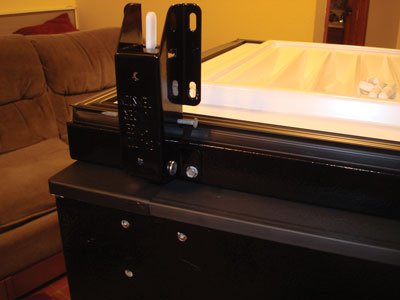
The lid hinges are spring assisted, so to avoid injury the hinges must be locked in place before removing them. Put a nail through the small hole to lock the hinge, then remove the bolts holding the lid to the freezer body and remove the lid.
Flip the freezer upside down on a rug or a few pieces of cardboard. The metal frame is not rigid enough to support casters directly, so I installed 0.125-inch (0.32 cm) steel bar stock to reinforce it. Then I installed a pair of 3-inch (7.6 cm) fixed casters on the left side and a pair of swiveling casters on the right (from harborfreight.com).
2. Build the collar
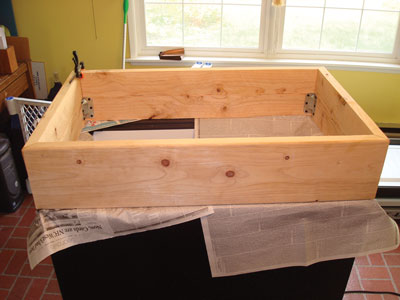
There are two surfaces to hold kegs inside the freezer; the freezer floor and the compressor hump. The freezer floor can hold three Cornelius kegs without modification, but I was really looking to have four kegs. The compressor hump can hold one more, or possibly two, but the lid must be raised 7.25 inches (18 cm) for it to fit. As luck would have it, the height of a standard 2×8 board is exactly 7.25 inches (18 cm).
The lid seal, then, is 1 inch (2.5 cm) wide, so I needed at least that much width for it to seal against. The 2×8 is 1.5-inch (3.8 cm) wide, so it is also a good choice for that. I picked up some 2×8 boards at Home Depot.
I decided to thin down the boards to 1.25 inches (3.2 cm) because the lid seal requires only one inch, and there is an existing 0.25-inch (0.64 cm) round-over on the boards. Thinning down the boards maximizes the thickness of insulation that will fit inside the collar without interfering with the inside available area, and it also saves a little weight. This step is optional. You can also just use thinner insulation inside the collar. I built the collar on top of the freezer to make sure it would fit well and installed metal corner reinforcement inside the corners.

3. Cut holes, install controller
I put the holes for the taps fairly high on the collar to place them at a convenient height. The holes are on 4-inch (10-cm) centers to fit my drip tray. I also cut a rectangular hole for the Love temperature controller (Dwyer Instruments, Inc). I used a 1-inch hole saw for the taps, but I later realized that a 7⁄8-inch saw is actually a better fit. After that you can stain the wood.
I worried that the collar would dislodge unless I firmly held it down to the freezer body, so I cut brackets, or cleats, from 0.75-inch (1.9 cm) aluminum angle bar. I placed the collar on a bed of adhesive caulking on top of the freezer body, then screwed the aluminum cleats in place. Each cleat has two screws going into the plastic top on the freezer body and one wood screw into the collar. The collar has a coat of polyurethane on the inside to resist moisture. I laid a bead of caulking inside the collar to make sure no moisture would wick underneath it.
4. Kegerator wiring
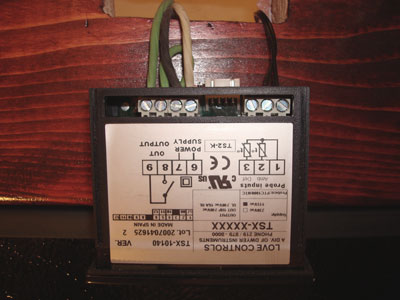
NOTE: If you are not comfortable with electrical wiring, consult an electrician. You can also use a plug-in temperature controller, which does not need new wiring. The SJOOW-rated, three-conductor cable runs from the Love temperature controller (inside the collar) to the back, then out through the collar and down the back to the compressor compartment. The controller receives power on terminals 6 and 7 (black live; white neutral). There is a jumper (short green wire) between terminals 7 and 8, providing power for the compressor relay, and the compressor is connected to the controller’s terminal 9 (green). Also shown is how to connect the included temperature sensor at terminals 1 and 2. In the compressor compartment I cut the wire after the original thermostat and inserted the new controller (terminal 9) in place. This wire provides power to the compressor, while the original thermostat provides power through the other cut end to the new controller via terminal 7. This way the original thermostat serves as a master switch by which all power can be turned off.
(In normal operation the original thermostat is set to its lowest temperature, allowing the Love controller to control the temperature.)
Also shown in the compressor compartment is a small 6V DC plug-in type transformer, attached to the frame rail with electrical tape (to the front and left of the compressor.) This transformer provides power to a computer fan inside the kegerator, circulating air into the collar section. Normally I leave the switch on “Auto,” but when I have a new keg to chill I turn it to “On” for a few hours to speed up the cooling. Additionally, I have a micro-switch that senses the lid opening and shuts off the fan.
5. Insulate collar, install gas manifolds
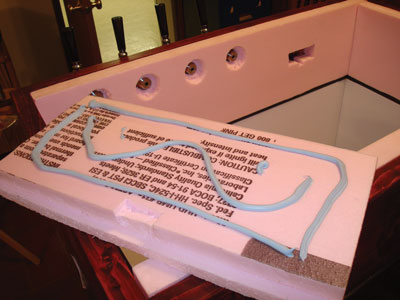
Unlike the freezer walls, the inside walls of the collar do not have refrigerant flowing through them. To make matters worse, heat rises and cold sinks, so that the warm air will collect under the lid in the collar area and the cold air will collect on the bottom. Why is this a problem? The faucets, and especially the beverage tubing, get heated by the warmer air in the collar, which makes the beer foam excessively. I have two remedies: first, I insulated the inside of the collar so that a minimum of heat will conduct from the outside in. Second, I installed a fan inside the freezer which will circulate the cold air from the bottom up. I used a 1.5” foam board to insulate the collar. Before installing the foam panels I installed 3” stainless steel faucet shanks since 3” shanks are a better fit than the more common 4” variety.
Next, when planning my gas set up, I decided that I wanted two different pressures of CO2: a high pressure for quick force-carbonating and a low pressure for serving.
This meant that I needed two gas manifolds. I chose a two-output manifold for the high pressure and a four-output manifold for the low pressure, which I found at homebrewstuff.com. Hanging the manifolds from hanger bolts (machine screw at one end, wood screw at the other) makes it easy to detach the manifolds should it become necessary.
I decided to install the CO2 bottle on the back to save space inside the kegerator. I fabricated a bottle hanger from 0.125” thick steel bar stock using a cut-off saw and my stick welder. I used a nylon web strap from Ebay to hold the bottle at the lower end and a metal clamp secured with an eye lag screw at the upper end. Eye lag screws are hard to find but I found mine on Amazon.com. They are typically used to suspend office ceilings.

6. Install drip tray and bottle opener, assemble fan
Drip trays can be very expensive. I found my 19.25-inch (23-cm)-wide drip tray on eBay for about $20.00, but you can find them in a variety of places online, such as www.micromatic.com. I also got three shelf brackets from a home improvement store, which I attached first to the drip tray and then to the freezer. The brackets are attached by heavy-duty double-sticky tape, 3M Scotch 4011 Exterior Mounting Tape, 1-inchx60-inches. Do not attempt to drill holes in the freezer wall because it is riddled with refrigerant lines. There are many different bottle openers available with various catching messages. The cap catcher is also attached with the exterior mounting tape. I have experimented with various placements of the fan, which is a 120 mm 12V computer fan I got from eBay, although you can find a similar sized fan at McMaster-Carr or Grainger. I used a 3-inch PVC sewer pipe with several holes drilled around the bottom perimeter using a 1-inch hole saw. The fan is fitted to the pipe by a rubber adapter I found at Home Depot.


