Portable RO System: Water on the go

Maybe like me you have come to realize the importance that water and water chemistry plays in the flavor of the beer you brew. And maybe like me you have also wanted to take control of the mineral composition of the water you use for brewing so you can dial in a particular profile for that perfect helles, NEIPA, or saison. If you want help with that . . . I’m not your guy. I’ll be the first to admit that I bought, read, and understood little in Water: A Comprehensive Guide for Brewers by John Palmer and Colin Kaminski.
Realizing I’m not an expert and being okay with that I made it my goal to make the water modification process as easy and repeatable as possible. Those goals were part of the reason I started using reverse osmosis (RO) water instead of carbon-filtered water from my tap. Using RO water means I am essentially starting from a blank slate every time I sit down to design a water profile for a beer I’m brewing. That’s because the mineral profile of RO water, unlike that of my tap water, doesn’t change with the seasons, doesn’t change based on the water source the treatment plant may be using that day/week/month, doesn’t change based on the amount of rain or snow fall, etc. It’s really consistent. And consistency is important in brewing if you want to brew the best beer possible.
Well . . . necessity is the mother of invention so I designed a cart that would hold my RO system . . .
But as with most things there are some cons to go along with the pros. The biggest con for me was the initial investment. I knew I was going to drop a bit of my brewing allowance on a nice RO system. But I was already buying 5–10 gallons (19–38 L) of distilled water at $1 per gallon ($0.27 per L) for many of my brew days, so I knew it wouldn’t take long for the system to pay for itself. Another con was that fact that the majority of RO water filter systems are meant to be mounted to a wall and semi-permanently plumbed into a water source. I was not in a position to be able to do this so I knew I’d have to figure out another solution.

Well . . . necessity is the mother of invention so I designed a cart that would hold my RO system, holding tank, and all the necessary items needed to move the RO water out of the holding tank and into my brewing kettles. It’s not connected into my home’s plumbing system. Instead it’s mounted to the cart, can be moved to the sink where I let the RO system do its work, and then I move it back to my brewing space to be used to make delicious beer.
So for those who don’t have the space, option, or desire to permanently install an RO system, a mobile cart might be a great option for you. The only feature I’m considering adding in the future is a water heater element and timer. With this I could have my brewing water both filtered and ready for mashing in when I wake up.
Tool and Materials
• RO water filtration system with float valve (http://wholesale.spectrapure.com/CSP-Manual-Flush-90-GPD-RO-System)
• Hydraulic lift table (https://www.harborfreight.com/61405.html)
• 1⁄2-in. weldless bulkhead
• Edge pickup diptube
• 1⁄2-in. ball valve
• 12V DC pump
• HDPE water barrel or other storage tank
• Pegboard or plywood
• 13⁄16-in. spade bit
• 7⁄16-in. spade bit
• Electric drill
Step by Step

1. Source The RO System
The first step is purchasing a reverse osmosis (RO) system. There are a lot of manufacturers out there. I purchased the CSP-90-MF made by SpectraPure. This RO system supplies 90 gallons (340 L) of RO water per day and came with the features I was looking for in an RO system. Plus it came with a float valve that will automatically shut the flow of water off once it reaches a certain level. It also came with an inline TDS (total dissolved solids) meter that is helpful for monitoring the effectiveness of the RO membrane.
2. Cart considerations
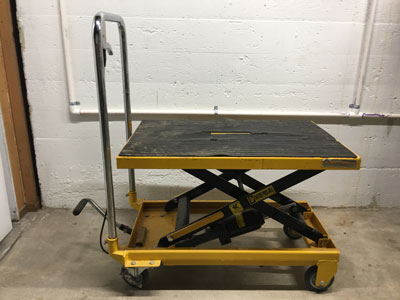
For the cart I used a hydraulic lift table with a lift capacity of 500 lbs. (227 kg) meaning it can easily bear the load of many a barrel full of water. If you don’t want or need the ability to lift the water, there are cheaper rolling carts that would work well. And the chief feature of a cart (wheels) means I can move it to my basement sink or hose spigot and then into the brewery where I ultimately need the water.
3. Obtain An Appropriate Barrel OR other vessel to hold the water
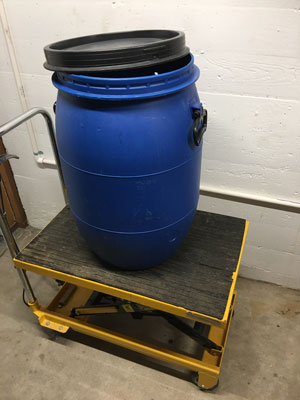
For RO water storage I used an HDPE barrel that was previously used to hold food-grade glycol for a local craft brewery. These types of HDPE barrels can be found rather cheap on Craigslist and other places. Just be sure to buy one that hasn’t been used to store something that will leech undesirable flavors into your water. And regardless of what it stored, be sure to clean in thoroughly prior to its first use.

4. Install Outlet
To drain the RO water out of the barrel I installed a diptube and weldless bulkhead I sourced from BrewHardware.com. I used the diptube designed for edge pickup attached to a 1⁄2-in. male NPT Weldless Bulkhead. To install the bulkhead I drilled a 13⁄16-in. hole in the side of the barrel with a spade bit. After that I added a 1⁄2-in. ball valve and attached a 12-volt DC water pump to it. Because I mismatched my thread types, I ended up with a male-to-male connection. This was remedied by using a short section of silicone hose and a hose clamp. And since the pump didn’t have a built-in switch, I added a plug-in power switch.

5. Mount The RO system
With the storage tank nearly complete, it’s time to get the RO system attached to the cart. How you do this is up to you. I had some spare pegboard from another project and cut it to span the distance between the upright sections of the cart’s handle and then secured it with zip ties. The pegboard holes didn’t line up perfectly with the RO system hanging bracket so I drilled two holes, installed bolts, washers, and nuts and then hung the RO system on the board. I noticed a slight gap between the filter housings and the mounting board so I installed a scrap piece of wood to give the filter housings something to rest against and eliminate any stress on the mounting bracket.

6. Float Switch
The last thing to do was install the float valve. I drilled a 7⁄16-in. hole near the top of the water barrel and installed the float valve and then connected it to the RO system. The cart was now ready to go. I wheeled it over to the basement sink and used a garden hose connector that came with my RO system to hook it up. I let the water run overnight and came down on brew day to find that the float valve had automatically stopped the flow of water once the barrel was full. I now had plenty of RO water ready for brew day.