Stainless Steel Auto-siphon: A novel approach to priming a siphon

My path into homebrewing is a familiar tale. I started brewing in a single pot, which slowly over time morphed into a three-pot, fly-sparge system for 10-gallon (38-L) batches. I call a modified stainless conical fermenter my own. The system benefits from a wide range of Brew Your Own magazine projects and hacks, like etched volume markings in the kettle, silver soldered tri-clamp flanges inserted with a homemade dimple tool, wig-welded tri-clamp flanges for the conical, and temperature probe made from a Corny keg dip tube. The technique for the temperature probe came in handy for the motorized mash stirrer with PID temperature controller for the induction heater as well. The copper immersion chiller was a very nice build as well.
After all the upgrades of my brew system I found more and more parts had to be carried from the basement upstairs every brew day and more parts had to be cleaned as well. The perfection of the system led unwillingly to a brew day that had to be planned way too long ahead to fit in our family’s schedule and therefore had me brewing less often.
When I read the BYO article on small-batch brewing in the May-June 2021 issue I realized that brewing smaller brew-in-a-bag (BIAB) batches in-between the big brew days would be the perfect middle ground for my lack of time. The 47-L (12.4 gallon) kettles I own are not practical to use on a kitchen stove, and therefore I purchased a 25-L (6.6-gallon) pot to brew BIAB batches.
I decided I would not want to add any valves to my small pot so I wouldn’t have to worry about seats or sealings or drilling holes (which I had been through a lot). Siphoning the wort out of this pot is no problem at all.

The polycarbonate auto-siphon I own made me often wonder if there wouldn’t be a stainless version. So after having learned so many metalworking skills due to the previous DIY projects, I decided to build a stainless auto-siphon. I really admire the ingenuity of some of the stainless racking canes/auto-siphons out there for reasonable prices. But here in Germany availability of new products is an issue and when you have an itch for DIY equipment, I think it’s rewarding and a lot of fun to innovate.
Since this auto-siphon build is all stainless steel it is therefore resistant to heat, breaking, and certain disinfectants, which polycarbonate is not. And it can completely be taken apart for cleaning. My initial plan for my BIAB system was to have fewer parts to clean. Oh well, at least I’m underway to spend more time brewing.
Tools and Materials
- 0.5 m (1.6 ft.) 12-mm (1⁄2-in.) OD stainless steel tube (or whatever length seems appropriate for your vessel)
- 1 m (3.2 ft.) 10-mm (3⁄8-in.) ID silicon hose
- (2) ¼-in. stainless steel outside threaded end caps
- (1) ¼-in. stainless steel coupler, 1 in. (2.5 cm) long
- Button washer head screw M4 x 10 mm
- Silver solder, solder flux, and solder torch
- 1-mm diameter stainless steel welding rod ~5 cm (2 in.) long
- 4-mm (5⁄32-in.) metal drill bit, oil, drill (drill press preferred)
- Die grinder and sand paper
Steps

1. Bending the knee
When looking for a stainless tube, make sure it is heat pretreated and therefore easy to bend. Also reassure that the tube’s inside is seamless and therefore doesn’t harbor any sanitary issues. There are several ways to bend a stainless tube without kinks. One way is to insert a metal spiral inside and bend it over a round solid object with the desired radius. Another method is to fill the tube with sand, compacting the sand with a stick and seal the ends of the tube with duct tape. This will provide some support from the inside and minimizes the risk of kinks. I used the compacted sand and combined it with a metal spiral on the outside, which is optional.
2. Soldering the ¼-in. thread
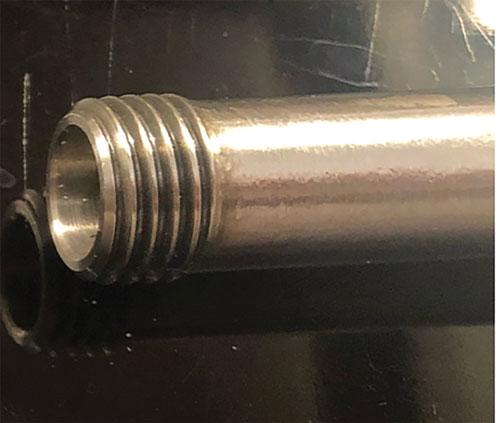
So this step may be omitted if you can get your hands on a tube with the right thread already attached or you come up with another method to attach the cane to the intended valve head. Since ¼-in. thread parts were at hand I didn’t bother. I cut the thread off of one of the ¼-in. end caps and soldered it to the straight end of the tube using a crème brûlée burner. Therefore I bent a small piece of silver solder into a ring of the same diameter of the thread and the tube. Apply sufficient flux agent and stack the silver solder and the thread on top of the tube. Use a vice to hold the tube upright. When I did it a second time I realized it is quite tricky to align the thread perfectly to the tube when the solder starts to liquify. So if you stick a piece of bent copper wire inside, the right alignment is mostly preset and there is one less thing to worry about when the metal gets hot.

3. Drilling holes in the valve head
Now the body of the valve head needs to be prepared. The second end cap was screwed in the small ¼-in. coupler. I drilled six 4-mm (5⁄32-in.) holes so that the open side of the end cap remained intact. This is crucial since you need the rim intact to be able to build a seal with the button washer head screw. The holes were drilled using oil, high pressure, and low rpm with my cordless drill. If you own or have access to a drill press though, I would advise using it. Through these holes the wort will flow inside the cane. Afterwards I used a die grinder and sand paper to smooth out all the sharp edges.

4. Preparing button washer head screw
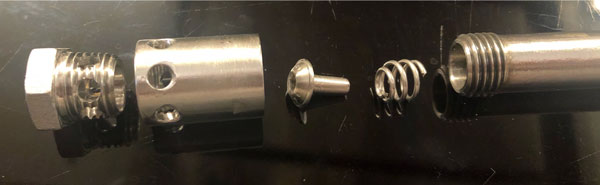
The button washer head screw was chosen because the convex side fits snuggly in the open end of the remaining ¼-in. end cap. I sanded the head of the screw to still find its way into the end cap but having enough room between the walls of the ¼-in. coupler for the wort to flow. The threads of the button washer head screw were sanded down with a power tool.The before and after pictures are found to the right.
5. Bending a stainless steel spiral
The stainless welding rod was bent into a spring, which fits tight inside the soldered ¼-in. thread and has a narrower winding on the outside so that the smooth ground part of the button washer head screw will slide nicely inside. I used three-jaw pliers for this job but anything you can wrap some wire around will perform fine as well. The free movement of the modified screw inside the valve head is crucial to the functionality of this device.

6. Assembly and performance
Once all parts are put together, the button washer head screw will form a check valve for the incoming wort. Giving the cane a few strokes (think shake-weight jiggling) will pull the wort up to the elbow where it will run into the silicone hose and build a steady suction typical for auto-siphons used by homebrewers.